A small collection of Raspberry Pis can be a useful place to work through a much bigger systems problem: how do we let software do useful work with sensitive information without giving every part of the system access to everything?
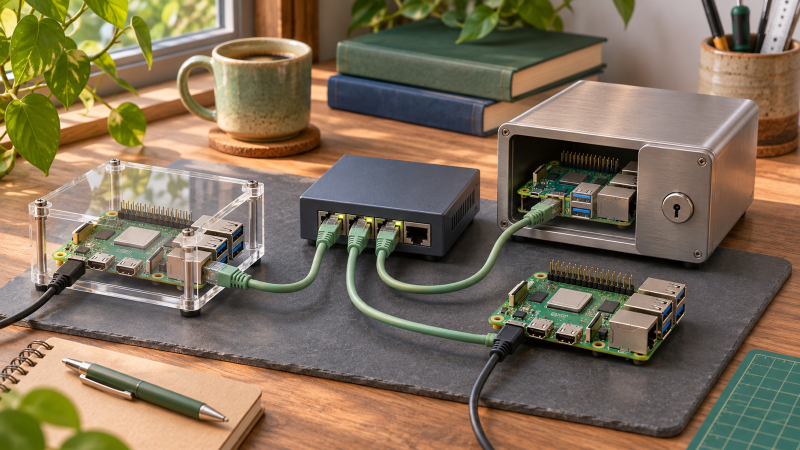 The setup I have in mind starts with two Pis. One handles a small, carefully defined piece of sensitive processing. Another runs a secrets vault. A laptop can be the application that calls them. Add another Pi or two, and the application, processing, secret storage, and observation can each have their own home.
That gives us somewhere to learn, prototype, and test an architecture that might eventually belong on very different hardware.
What interests me is how physical separation makes the design easier to think about. There is a machine making a request, a machine doing the sensitive work, and a machine deciding whether to allow access to a secret. Each connection forces a question about trust.
Before plugging anything in, though, there is one distinction to get right.
A Pi can teach the TEE model
A trusted execution environment, or TEE, provides a protected place to run code and handle data. In confidential computing, that protection rests on hardware isolation and attestation: evidence another party can check about the environment receiving its data. The Confidential Computing Consortium’s definition makes both elements central.
Putting a program on a dedicated Pi gives it a separate machine. Whether that machine provides a secure TEE depends on the exact board and software stack.
There is a particularly useful example in the OP-TEE documentation for Raspberry Pi 3. OP-TEE is software for building trusted applications using Arm TrustZone. Its Pi 3 port is explicitly intended for education and prototyping; the documentation warns that the platform lacks mechanisms needed for a secure implementation.
That makes it useful for learning how trusted applications and their ordinary operating-system clients interact. It does not establish that secrets are protected from a compromised host.
I would approach the processing Pi in two stages. Start with a restricted Linux service to learn the application boundaries. Then, if learning TEE programming is the goal, use the documented Pi 3 OP-TEE environment to explore the trusted-application model. Those are different experiments, with different software requirements. Neither justifies a production confidentiality claim.
Secure boot is another useful lesson, but it answers a different question. Raspberry Pi documents verified boot and storage encryption for supported configurations. Verifying what starts does not, by itself, establish that a running workload’s memory is protected from its host.
The lab becomes much more valuable when we keep those distinctions visible.
Give each machine a specific responsibility
I would build around three roles, with an optional fourth.
The application makes requests. This can begin on a laptop and later move to another Pi. It might be a small web application, an automation, or an AI agent. Its job is to request an allowed operation and consume the result.
The processing Pi does a narrow piece of work. This is where we prototype the role that might later move into a TEE. Perhaps it calculates an approved summary from a synthetic dataset or checks whether a document meets a release rule. Its interface should describe those operations precisely.
The vault Pi controls secrets and cryptographic operations. For a concrete implementation, HashiCorp publishes Vault binaries for Linux ARM64. I would check the selected release against the board and operating system, then keep this machine dedicated to the vault role.
An optional observer Pi collects evidence. Request identifiers, authorization decisions, timing, and failure events can help explain what happened across the other machines. The logging design should deliberately exclude credentials and sensitive payloads.
The intended path is straightforward: the application calls the processing service; the processing service authenticates to the vault for a specific permitted operation; the application receives only the approved result.
I would put this on a lab network with explicit connection rules and separate administrative credentials. A network address can help route or filter traffic. The service still needs to establish who is asking and what that identity may do.
Two Pis are enough to begin. Additional machines let us vary the caller, observe the system independently, and explore failures without turning one device into every component at once.
Make the vault do more than hold passwords
The first version of a secrets project often replaces a password in a configuration file with an API call that retrieves the same password.
That is a useful starting point. There is more to learn by asking whether the application needs possession of a secret at all.
Vault’s Transit secrets engine exposes operations such as encryption, decryption, signing, and verification. An application can request a signature while leaving the signing key under the vault’s control. Keeping key export disabled is part of that design.
For credentials that applications do need, I would explore supported dynamic secrets and their renewal and revocation behavior. There is an important distinction here: Vault’s lease documentation explains that ordinary key/value secrets do not receive leases. Storing a static API key in a vault does not automatically make that key temporary.
The processing service should have a narrowly scoped identity of its own. Vault supports client-certificate authentication, for example. The application should not inherit the processing service’s permissions, and neither should run with the vault administrator’s authority.
There is also a limit worth learning early. A software vault on a Pi has a host operating system and sensitive runtime memory. HashiCorp’s hardening guidance addresses that exposure, including swap and core dumps. A separate vault machine helps establish a boundary; its presence alone does not provide hardware protection for keys.
Choose a small experiment with a clear result
For a first project, I would use fabricated records and disposable keys. Imagine a tiny reporting application that is allowed to obtain a summary but should never receive the underlying individual records.
The application requests a named report. The processing Pi validates the caller and the requested dataset. It uses its own limited vault permissions to request a Transit decryption operation, calculates the approved summary, and returns that result. In this version, both the vault and the worker handle plaintext, so the design trusts both machines with it.
The application gets no general decrypt endpoint. The worker gets no permission to administer the vault. A request identifier lets us connect the decisions across the system.
This experiment also exposes where plaintext exists. If an ordinary Linux process receives decrypted records, the lab’s confidentiality boundary includes that operating system. Sending data over TLS to the Pi does not make the data inaccessible to privileged software after the connection terminates.
For a later TEE implementation, I would trace the entire path again: where input is decrypted, where keys arrive, where processing happens, and what leaves the protected environment. Moving one function into a TEE does not automatically move every buffer and connection there with it.
The output deserves equal attention. A narrowly defined summary can still disclose too much if repeated requests let someone infer individual values. The prototype gives us a place to consider minimum group sizes, query limits, and approval rules before real data is involved.
Learn from the conditions around the successful request
A successful report is only the beginning. I would keep a short notebook of experiments and expected outcomes:
- Remove the caller’s permission. New requests should be denied, with a clear record of the decision.
- Expire an application credential. Observe renewal, denial, and recovery, including what happens to existing sessions.
- Disconnect the vault. Decide which work stops, what can safely be retried, and whether any cached material has a defined lifetime.
- Restart the processing Pi. Check temporary files, recovery behavior, and whether a repeated request causes duplicate work.
- Replace a software image. Record what the lab actually verifies and which integrity checks the future platform must add.
- Restore the vault on a replacement device. Verify that the backup and the separately retained recovery material are sufficient.
These are design experiments using the lab’s own services and test data. The useful result is a record of behavior: what we expected, what happened, and what needs to change.
I would also move beyond Vault’s convenient development mode once restart and recovery become part of the experiment. Its development server documentation explains that the defaults are insecure and its in-memory data disappears on restart. Persistent storage, TLS, and a deliberate unseal process let the lab teach more realistic operating lessons.
The seal and unseal model raises a particularly good question: what must be available before the vault can make its secrets available? With manual unsealing, keeping every unseal share beside the server would defeat much of the intended separation.
Even the physical arrangement teaches something. Several Pis on one power strip and one switch share obvious failure points. Separate machines give us useful boundaries to explore, while availability still requires its own design.
Carry the design into the enterprise version
The most useful things to take out of this lab are the interfaces, permission rules, data-flow diagrams, failure expectations, and repeatable tests.
The production platform then has to supply and demonstrate the protections the prototype could only model.
For sensitive computation, that may mean a supported TEE platform with an appropriate threat model, maintained firmware, and verified attestation. For key custody, it may mean a managed key service or hardware security module, depending on the required controls. Availability introduces further work around redundancy, independent failure domains, backups, and recovery.
Attestation changes the decision about releasing secrets. A certificate can establish that a caller possesses an accepted credential. An attestation policy can additionally require evidence about the execution environment and software measurements before permitting a cryptographic operation.
There are concrete examples of that pattern. AWS Nitro Enclaves supports attestation-based access policies, and AWS KMS can encrypt an attested response to a public key carried in the attestation document. That provides a useful reference for designing how key material reaches an approved environment.
A simulated attestation response in a Pi lab can exercise application logic. The enterprise implementation must validate genuine evidence, its freshness, its trusted source, and its binding to the recipient. The application and recovery tests need to run again against that implementation.
Some code will change. An OP-TEE trusted application and a cloud enclave have different interfaces and operating constraints. Keeping the sensitive function small, with explicit inputs and outputs, gives us a better starting point for that work.
Leave the lab with better questions
This connects with something I have written about before: thinking shapes systems, and systems determine the tools.
A few Pis give that process something tangible to work with. We can draw a boundary, build a small version of it, interrupt a dependency, and see whether our understanding survives the experiment.
By the time an enterprise platform enters the picture, we should be able to explain which component needs each secret, what evidence authorizes its use, where plaintext exists, how access ends, and how the system recovers.
That seems like a worthwhile outcome for a small pile of computers: a clearer design, a record of what we learned, and better questions to ask before the stakes get larger.

