Three Field Guides for the Security Problems Showing Up Right Now

Over the last several months, we have released three longer-form guides around problems we keep seeing in real environments:

  • The Antifragile SOC Book

  • The AI Agents Management Framework

  • The Security Leader’s Operating System

They cover different areas, but they share a common theme: how to operate effectively as complexity, automation, and pressure increase.

Books

Why We Created These Materials

These guides did not begin as content projects.

They came from working problems.

Over the years, we have accumulated a lot of models, processes, questions, and operating approaches that we use when helping organizations solve difficult security problems. Some came from client work, some from research, and plenty came from lessons learned the hard way.

Much of that knowledge lived in conversations, notes, presentations, and experience.

We decided it was time to write more of it down.

Not as theory, and not as another collection of cybersecurity predictions.

As practical field material people can use, challenge, adapt, and apply.

Why Release Them Now?

The timing matters.

Security teams are being asked to handle more data, more tooling, more organizational expectations, and more complexity.

At the same time, AI is moving rapidly from experimentation into real operational workflows.

And security leaders are increasingly being asked to manage all of this while making faster decisions with broader consequences.

The answer cannot simply be to do more.

More alerts. More automation. More dashboards. More meetings. More processes.

What we increasingly need are better operating models.

That is what these three guides are intended to provide.

The Antifragile SOC Book

Most SOCs are very good at generating activity.

The harder question is whether that activity is actually improving security.

The Antifragile SOC Book looks at how security operations can move beyond simply absorbing alerts and incidents toward continuously learning from them.

It is about building a SOC that gets better under pressure, focuses scarce analyst attention where it matters, and treats noise, friction, and failure as signals for improvement.

If you run, manage, or depend on a SOC, this one is for you.

Download The Antifragile SOC Book:

https://media.microsolved.com/The_Antifragile_SOC_Book.pdf

The AI Agents Management Framework

AI agents are quickly moving from interesting experiments into systems that can retrieve data, use tools, trigger workflows, and take action.

That creates a new management problem.

The AI Agents Management Framework is built around a simple idea: once an AI agent can act on behalf of the organization, it should be governed more like a digital worker than a traditional application.

The guide provides a practical way to think about ownership, authority, access, monitoring, risk, and accountability as agents become more capable.

If your organization is deploying agents beyond simple chat interfaces, now is the time to think about how they will be managed.

Get the AI Agents Management Framework:

https://signup.microsolved.com/ai-management-e-book/

The Security Leader’s Operating System

The third guide is the most personal.

Capable security leaders tend to attract work.

Eventually, incidents, exceptions, decisions, meetings, escalations, and unfinished problems can consume all of the time that was supposed to be used for leadership.

The Security Leader’s Operating System captures the approach I use to decide what should disappear, what should move to someone else, what should be simplified, what should be automated, and what genuinely deserves a leader’s attention.

It is not another productivity system for processing an infinite queue faster.

It is about redesigning the queue.

If you are a security leader who has become the default destination for every difficult problem, this one may be the most useful of the three.

Download The Security Leader’s Operating System:

https://media.microsolved.com/The_Security_Leaders_Operating_System.pdf

The Common Thread

I did not originally think of these as a series.

But they keep converging on the same questions.

Where should human attention go?

What should we automate?

What should remain under human judgment?

How do we distinguish useful outcomes from simple activity?

And how do we build systems that improve instead of merely accumulating more work?

Those questions are becoming more important as AI and automation make it easier to do more things, faster.

The challenge is no longer just whether something can be done.

It is deciding what is worth doing.

That is why we are releasing these materials now.

If one of these problems is showing up in your organization, grab the relevant guide, read it, challenge it, and put something from it into practice.

The Antifragile SOC Book
https://media.microsolved.com/The_Antifragile_SOC_Book.pdf

The AI Agents Management Framework
https://signup.microsolved.com/ai-management-e-book/

The Security Leader’s Operating System
https://media.microsolved.com/The_Security_Leaders_Operating_System.pdf

Use what works.

Discard what does not.

And, ideally, make the system better.


* AI tools were used as a research assistant for this content, but human moderation and writing are also included. The included images are AI-generated.
Your First AI‑Assisted Research Project: A Step‑by‑Step Guide

Transforming Knowledge Work from Chaos to Clarity

Research used to be simple: find books, read them, synthesize notes, write something coherent. But in the era of abundant information — and even more abundant tools — the core challenge isn’t a lack of sources; it’s context switching. Modern research paralysis often results from bouncing between gathering information and trying to make sense of it. That constant mental wrangling drains our capacity to think deeply.

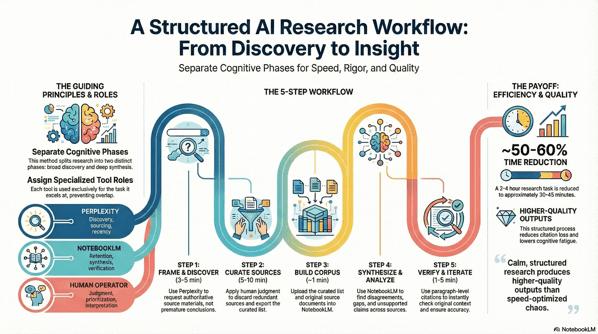
This guide offers a calm, structured method for doing better research with the help of AI — without sacrificing rigor or clarity. You’ll learn how to use two specialized assistants — one for discovery and one for synthesis — to move from scattered facts to meaningful insights.

Unnamed 3


1. The Core Idea: Two Phases, Two Brains, One Workflow

The secret to better research isn’t more tools — it’s tool specialization. In this process, you separate your work into two clearly defined phases, each driven by a specific AI assistant:

Phase Goal Tool Role
Discovery Find the best materials Perplexity Live web researcher that retrieves authoritative sources
Synthesis Generate deep insights NotebookLM Context‑bound reasoning and structured analysis

The fundamental insight is that searching for information and understanding information are two distinct cognitive tasks. Conflating them creates mental noise that slows us down.


2. Why This Matters (and the AI Context)

Before we dive into the workflow, it’s worth grounding this methodology in what we currently know about AI’s real impact on knowledge work.

Recent economic research finds that access to generative AI can materially increase productivity for knowledge workers. For example:

  • Workers using AI tools reported saving an average of 5.4% of their work hours — roughly 2.2 hours per week — by reducing time spent on repetitive tasks, which corresponds to a roughly 1.1% increase in overall productivity

  • Field experiments have shown that when knowledge workers — such as customer support agents — have access to AI assistants, they resolve about 15% more issues per hour on average. 

  • Empirical studies also indicate that AI adoption is broad and growing: a majority of knowledge workers use generative AI tools in everyday work tasks like summarization, brainstorming, or information consolidation. 

Yet, productivity is not automatic. These tools augment human capability — they don’t replace judgment. The structured process below helps you keep control over quality while leveraging AI’s strengths.


3. The Workflow in Action

Let’s walk through the five steps of a real project. Our example research question:
What is the impact of AI on knowledge worker productivity?


Step 1: Framing the Quest with Perplexity (Discovery)

Objective: Collect high‑quality materials — not conclusions.

This is pure discovery. Carefully construct your prompt in Perplexity to gather:

  • Recent reports and academic research

  • Meta‑analyses and surveys

  • Long‑form PDFs and authoritative sources

Use constraints like filetype:pdf or site:.edu to surface formal research rather than repackaged content.

Why it works: Perplexity excels at scanning the live web and ranking sources by authority. It shouldn’t be asked to synthesize — that comes later.


Step 2: Curating Your Treasure (Human Judgment)

Objective: Vet and refine.

This is where your expertise matters most. Review each source for:

  • Recency: Is it up‑to‑date? AI and productivity research moves fast.

  • Credibility: Is it from a reputable institution or peer‑reviewed?

  • Relevance: Does it directly address your question?

  • Novelty: Does it offer unique insight or data?

Outcome: A curated set of URLs and a Perplexity results export (PDF) that documents your initial research map.


Step 3: Building Your Private Library in NotebookLM

Objective: Upload both context and evidence into a dedicated workspace.

What to upload:

  1. Your Perplexity export (for orientation)

  2. The original source documents (full depth)

Pro tip: Avoid uploading summaries only or raw sources without context. The first leads to shallow reasoning; the second leads to incoherent synthesis.

NotebookLM becomes your private, bounded reasoning space.


Step 4: Finding Hidden Connections (Synthesis)

Objective: Treat the AI as a reasoning partner — not an autopilot.

Ask NotebookLM questions like:

  • Where do these sources disagree on productivity impact?

  • What assumptions are baked into definitions of “productivity”?

  • Which sources offer the strongest evidence — and why?

  • What’s missing from these materials?

This step is where your analysis turns into insight.


Step 5: Trust, but Verify (Verification & Iteration)

Objective: Ensure accuracy and preserve nuance.

As NotebookLM provides answers with inline citations, click through to the original sources and confirm context integrity. Correct over‑generalizations or distortions before finalizing your conclusions.

This human‑in‑the‑loop verification is what separates authentic research from hallucinated summaries.


4. The Payoff: What You’ve Gained

A disciplined, AI‑assisted workflow isn’t about speed alone — though it does save time. It’s about quality, confidence, and clarity.

Here’s what this workflow delivers:

Improvement Area Expected Outcome
Time Efficiency Research cycles reduced by ~50–60% — from hours to under an hour when done well
Citation Integrity Claims backed by vetted sources
Analytical Rigor Contradictions and gaps are surfaced explicitly
Cognitive Load Less context switching means less burnout and clearer thinking

By the end of the process, you aren’t just informed — you’re oriented.


5. A Final Word of Advice

This structured workflow is powerful — but it’s not a replacement for thinking. Treat it as a discipline, not a shortcut.

  • Keep some time aside for creative wandering. Not all insights come from structured paths.

  • Understand your tools’ limits. AI is excellent at retrieval and pattern recognition — not at replacing judgment.

  • You’re still the one who decides what matters.


Conclusion: Calm, Structured Research Wins

By separating discovery from synthesis and assigning each task to the best available tool, you create a workflow that’s both efficient and rigorous. You emerge with insights grounded in evidence — and a process you can repeat.

In an age of information complexity, calm structure isn’t just a workflow choice — it’s a competitive advantage.

Apply this method to your next research project and experience the clarity for yourself.

Support My Work

Support the creation of high-impact content and research. Sponsorship opportunities are available for specific topics, whitepapers, tools, or advisory insights. Learn more or contribute here: Buy Me A Coffee


* AI tools were used as a research assistant for this content, but human moderation and writing are also included. The included images are AI-generated.