The Second Half: Building a Legacy of Generational Knowledge

“Build, establish, and support a legacy of knowledge that not only exceeds my lifetime, but exceeds generations and creates a generational wealth of knowledge.”

That’s the mission I’ve set for the second half of my life. It’s not about ego, and it’s certainly not about permanence in the usual sense. It’s about creating something that can outlast me—not in the form of statues or plaques, but in the ripples of how people think, solve problems, and support each other long after I’m gone.

ChatGPT Image Aug 2 2025 at 04 04 22 PM

Three Pillars of a Legacy

There are three key prongs to how I’m approaching this mission. Each one is interwoven with a sense of service and intention. The first is about altruism—specifically, applying a barbell strategy to how I support systems and organizations. The middle of the bar is the consistent, proven efforts that deliver value today. But at the ends are the moonshots—projects like the psychedelic science work of MAPS or the long-term frameworks for addressing food insecurity and inequality. These aren’t about tactics; they’re about systems-level, knowledge-driven approaches that could evolve over the next 50 to 100 years.

The second pillar is more personal. It’s about documenting how I think. Inspired in part by Charlie Munger, I’ve come to realize that just handing out solutions isn’t enough. If you want to make lasting impact, you have to teach people how to think. So I’ve been unpacking the models I use—deconstruction, inversion, compounding, Pareto analysis, the entourage effect—and showing how those can be applied across cybersecurity, personal health, and even everyday life. This is less about genius and more about discipline: the practice of solving hard problems with reusable, teachable tools.

The third leg of the stool is mentoring. I don’t have children, but I see the act of mentorship as my version of parenting. I’ve watched people I’ve mentored go on to become rock stars in their own right—building lives and careers they once thought were out of reach. What I offer them isn’t just advice. It’s a commitment to help them design lives they want to live, through systems thinking, life hacking, and relentless self-experimentation.

Confidence and Competence

One of the core ideas I try to pass along—both to myself and to my mentees—is the importance of aligning your circle of confidence with your circle of competence. Let those drift apart, and you’re just breeding hubris. But keep them close, and you cultivate integrity, humility, and effective action. That principle is baked into everything I do now. It’s part of how I live. It’s a boundary check I run daily.

The Long Game

I don’t think legacy is something you “leave behind.” I think it’s something you put into motion and let others carry forward. This isn’t about a monument. It’s about momentum. And if I can contribute even a small part to a future where people think better, solve bigger, and give more—then that’s a legacy I can live with.


* AI tools were used as a research assistant for this content, but human moderation and writing are also included. The included images are AI-generated.

Why Humans Suck at Asymmetric Risk – And What We Can Do About It

Somewhere between the reptilian wiring of our brain and the ambient noise of the modern world, humans lost the plot when it comes to asymmetric risk. I see it every day—in security assessments, in boardroom decisions, even in how we cross the street. We’re hardwired to flinch at shadows and ignore the giant neon “Jackpot” signs blinking in our periphery.

Asymetry

The Flawed Lens We Call Perception

Asymmetric risk, if you’re not familiar, is the art and agony of weighing a small chance of a big win against a large chance of a small loss—or vice versa. The kind of math that makes venture capitalists grin and compliance officers lose sleep.

But here’s the kicker: we are biologically terrible at this. Our brains were optimized for sabertooth cats and tribal gossip, not venture portfolios and probabilistic threat modeling. As Kahneman and Tversky so elegantly showed, we’re much more likely to run from a $100 loss than to chase a $150 gain. That’s not risk aversion. That’s evolutionary baggage.

Biases in the Wild

Two of my favorite culprits are the availability heuristic and the affect heuristic—basically, we decide based on what we remember and how we feel. That’s fine for picking a restaurant. But for cybersecurity investments or evaluating high-impact, low-probability threats? It’s a disaster.

Anxiety, in particular, makes us avoid even minimal risks, while optimism bias has us chasing dreams on gut feeling. The result? We miss the upsides and ignore the tripwires. We undervalue data and overvalue drama.

The Real World Cost

These aren’t just academic quibbles. Misjudging asymmetric risk leads to bad policies, missed opportunities, and overblown fears. It’s the infosec team spending 90% of their time on threats that look scary on paper but never materialize—while ignoring the quiet, creeping risks with catastrophic potential.

And young people, bless their eager hearts, are caught in a bind. They have the time horizon to tolerate risk, but not the experience to see the asymmetric goldmines hiding in plain sight. Education, yes. But more importantly, exposure—to calculated risks, not just textbook theory.

Bridging the Risk Gap

So what do we do? First, we stop pretending humans are rational. We aren’t. But we can be reflective. We can build systems—risk ladders, simulations, portfolios—that force us to confront our own biases and recalibrate.

Next, we tell better stories. The framing of a risk—description versus experience—can change everything. A one-in-a-thousand chance sounds terrifying until you say “one person in a stadium full of fans.” Clarity in communication is power.

Finally, we get comfortable with discomfort. Real asymmetric opportunity often lives in ambiguity. It’s not a coin toss—it’s a spectrum. And learning to navigate that space, armed with models, heuristics, and a pinch of skepticism, is the real edge.

Wrapping Up

Asymmetric risk is both a threat and a gift. It’s the reason bad startups make billionaires and why black swan events crash markets. We can’t rewire our lizard brains, but we can out-think them.

We owe it to ourselves—and our futures—to stop sucking at asymmetric risk.

Shoutouts:

This post came from an interesting discussion with two friends: Bart and Jason. Thanks, gentlemen, for the impetus and the shared banter! 


* AI tools were used as a research assistant for this content, but human moderation and writing are also included. The included images are AI-generated.

The Great Vendor Concentration Risk Circus: A Brave New World?

Hey folks, buckle up because we’re diving into a wild tale that became the talk of the tech town this past weekend—the CrowdStrike and Microsoft outage! As always, I’m here to keep it light on the details but heavy on the takeaways. So grab your popcorn, and let’s roll!

ConcentrationRisk

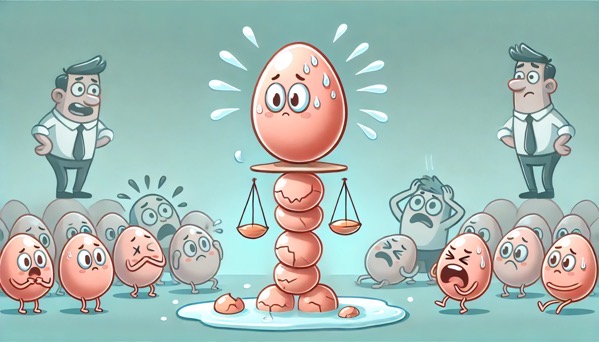
First up, let’s chat about vendor concentration risk. In simple terms, it’s like putting all your eggs in one basket, or as I like to call it—having one favorite vendor at the carnival. Sure, they may have the greatest cotton candy, but when the vendor runs out, or their machine breaks down, you’re left sad and craving sugar! That’s what this outage highlighted for everyone relying on cloud services and cybersecurity—if that one vendor stumbles, everyone in line ends up feeling it![2][4]

Now, what happened with CrowdStrike and Microsoft? Well, it turns out that a software update on July 18 flung a wrench in the gears of countless IT systems across the globe. Reports came flooding in from big-name institutions—banks, airlines, and even emergency services were caught in the chaos! Over 8.5 million Windows devices were affected, reminding us just how interconnected our tech ecosystems truly are.[3][4]

So, what can we learn from this whole spectacle? 

1. Diversify Your Vendors: Don’t just eat at one food stall! Utilize multiple vendors for essential services to reduce the fallout if one faces a hiccup.[1][2]

2. Communicate with Employees: Keep your team informed and calm during hiccups. This situation showed us how vital communication is during a tech mishap.  

3. Prepare for Disruptions: Have contingency plans! Know what to do if your vendors experience turbulence.[1][2]

In closing, while tech might have some dramatic glitches now and then, they are vital reminders of our interconnected world. Let’s take this as a fun little lesson in preparedness and resilience! Until next time, keep your systems and vendors varied and safe!


Citations:

[1] https://www.venminder.com/blog/pros-and-cons-of-vendor-concentration-risk

[2] https://mitratech.com/resource-hub/blog/what-is-concentration-risk/

[3] https://edition.cnn.com/2024/07/22/us/microsoft-power-outage-crowdstrike-it/index.html

[4] https://www.usatoday.com/story/money/2024/07/20/how-microsoft-crowdstrike-update-large-impact/74477759007/

[5] https://ncua.gov/regulation-supervision/letters-credit-unions-other-guidance/concentration-risk-0


 AI tools were used as a research assistant for this content.