Somewhere between the reptilian wiring of our brain and the ambient noise of the modern world, humans lost the plot when it comes to asymmetric risk. I see it every day—in security assessments, in boardroom decisions, even in how we cross the street. We’re hardwired to flinch at shadows and ignore the giant neon “Jackpot” signs blinking in our periphery.

The Flawed Lens We Call Perception
Asymmetric risk, if you’re not familiar, is the art and agony of weighing a small chance of a big win against a large chance of a small loss—or vice versa. The kind of math that makes venture capitalists grin and compliance officers lose sleep.
But here’s the kicker: we are biologically terrible at this. Our brains were optimized for sabertooth cats and tribal gossip, not venture portfolios and probabilistic threat modeling. As Kahneman and Tversky so elegantly showed, we’re much more likely to run from a $100 loss than to chase a $150 gain. That’s not risk aversion. That’s evolutionary baggage.
Biases in the Wild
Two of my favorite culprits are the availability heuristic and the affect heuristic—basically, we decide based on what we remember and how we feel. That’s fine for picking a restaurant. But for cybersecurity investments or evaluating high-impact, low-probability threats? It’s a disaster.
Anxiety, in particular, makes us avoid even minimal risks, while optimism bias has us chasing dreams on gut feeling. The result? We miss the upsides and ignore the tripwires. We undervalue data and overvalue drama.
The Real World Cost
These aren’t just academic quibbles. Misjudging asymmetric risk leads to bad policies, missed opportunities, and overblown fears. It’s the infosec team spending 90% of their time on threats that look scary on paper but never materialize—while ignoring the quiet, creeping risks with catastrophic potential.
And young people, bless their eager hearts, are caught in a bind. They have the time horizon to tolerate risk, but not the experience to see the asymmetric goldmines hiding in plain sight. Education, yes. But more importantly, exposure—to calculated risks, not just textbook theory.
Bridging the Risk Gap
So what do we do? First, we stop pretending humans are rational. We aren’t. But we can be reflective. We can build systems—risk ladders, simulations, portfolios—that force us to confront our own biases and recalibrate.
Next, we tell better stories. The framing of a risk—description versus experience—can change everything. A one-in-a-thousand chance sounds terrifying until you say “one person in a stadium full of fans.” Clarity in communication is power.
Finally, we get comfortable with discomfort. Real asymmetric opportunity often lives in ambiguity. It’s not a coin toss—it’s a spectrum. And learning to navigate that space, armed with models, heuristics, and a pinch of skepticism, is the real edge.
Wrapping Up
Asymmetric risk is both a threat and a gift. It’s the reason bad startups make billionaires and why black swan events crash markets. We can’t rewire our lizard brains, but we can out-think them.
We owe it to ourselves—and our futures—to stop sucking at asymmetric risk.
Shoutouts:
This post came from an interesting discussion with two friends: Bart and Jason. Thanks, gentlemen, for the impetus and the shared banter!
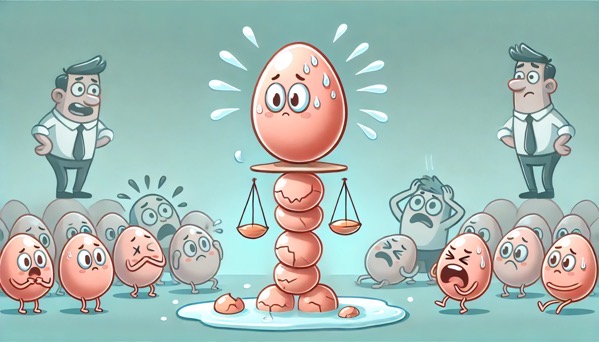
* AI tools were used as a research assistant for this content, but human moderation and writing are also included. The included images are AI-generated.
 Not Quite Random