Future Brent – A Mental Model: A 1% Nudge Toward a Kinder Tomorrow

On Not Quite Random, we often wander through the intersections of the personal and the technical, and today is no different. Let me share with you a little mental model I like to call “Future Brent.” It’s a simple yet powerful approach: every time I have a sliver of free time, I ask, “What can I do right now that will make things a little easier for future Brent?”

ChatGPT Image Dec 9 2025 at 10 23 45 AM

It’s built on three pillars. First, optimizing for optionality. That means creating flexibility and space so that future Brent has more choices and less friction. Second, it’s about that 1% improvement each day—like the old adage says, just nudging life forward a tiny bit at a time. And finally, it’s about kindness and compassion for your future self.

Just the other day, I spent 20 minutes clearing out an overcrowded closet. That little investment meant that future mornings were smoother and simpler—future Brent didn’t have to wrestle with a mountain of clothes. And right now, as I chat with you, I’m out on a walk—because a little fresh air is a gift to future Brent’s health and mood.

In the end, this mental model is about blending a bit of personal reflection with a dash of practical action. It’s a reminder that the smallest acts of kindness to ourselves today can create a more flexible, happier, and more empowered tomorrow. So here’s to all of us finding those little 1% opportunities and giving future us a reason to smile.

Hybrid Work, Cognitive Fragmentation, and the Rise of Flow‑Design

Context: Why hybrid work isn’t just a convenience

Hybrid work isn’t a fringe experiment anymore — it’s quickly becoming the baseline. A 2024–25 survey in the U.S. shows that 52% of employees whose jobs can be remote work in a hybrid mode, and another 27% are fully remote.

Other recent studies reinforce the upsides: hybrid arrangements often deliver similar productivity and career‑advancement outcomes as fully on-site roles, while improving employee retention and satisfaction.

Redheadcoffee

In short: hybrid work is now normal — and that normalization brings new challenges that go beyond “working from home vs. office.”

The Hidden Cost: Cognitive Fragmentation as an Engineering Problem

When organizations shift to hybrid work, they often celebrate autonomy, flexibility, and freedom from commutes. What gets less attention is how hybrid systems — built around multiple apps, asynchronous communication, decentralized teams, shifting time zones — cause constant context switching.

  • Each time we jump from an email thread to a project board, then to a chat, then to a doc — that’s not just a change in window or tab. It is a mental task switch.

  • Such switches can consume as much as 40% of productive time.

  • Beyond lost time, there’s a deeper toll: the phenomenon of “attention residue.” That’s when remnants of the previous task linger in your mind, degrading focus and decreasing performance on the current task — especially harmful for cognitively demanding or creative work.

If we think about hybrid work as an engineered system, context switching is a kind of “friction” — not in code or infrastructure, but in human attention. And like any engineering problem, friction can — and should — be minimized.

Second‑Order Effects: Why Cognitive Fragmentation Matters

Cognitive fragmentation doesn’t just reduce throughput or add stress. Its effects ripple deeper, with impacts on:

  • Quality of output: When attention is fragmented, even small tasks suffer. Mistakes creep in, thoughtfulness erodes, and deep work becomes rare.

  • Long-term mental fatigue and burnout: Constant switching wears down cognitive reserves. It’s no longer just “too much work,” but “too many contexts” demanding attention.

  • Team performance and morale: At the organizational level, teams that minimize context switching report stronger morale, better retention, and fewer “after‑hours” overloads.

  • Loss of strategic thinking and flow states: When individuals rarely stay in one mental context long enough, opportunities for deep reflection, creative thinking, or coherent planning erode.

In short, hybrid work doesn’t just shift “where” work happens — it fundamentally alters how work happens.

Why Current Solutions Fall Short

There are many popular “help me focus” strategies:

  • The classic — Pomodoro Technique / “deep work” blocks / browser blockers.

  • Calendar-based time blocking to carve out uninterrupted hours.

  • Productivity suites: project/task trackers like Asana, Notion, Linear and other collaboration tools — designed to organize work across contexts.

And yet — these often treat only the symptoms, not the underlying architecture of distraction. What’s missing is a system‑level guidance on:

  • Mapping cognitive load across workflow architecture (not just “my calendar,” but “how many systems/platforms/contexts am I juggling?”).

  • Designing environments (digital and physical) that reduce cross‑system interference instead of piling more tools.

  • Considering second‑ and third‑order consequences — not just “did I get tasks done?” but “did I preserve attention capacity, quality, and mental energy?”

In other words: we lack a rationalist, engineered approach to hybrid‑work life hacking.

Toward Flow‑Preserving Systems: A Pareto Model of Attention

If we treat attention as a finite resource — and work systems as pipelines — then hybrid work demands more than discipline: it demands architecture. Here’s a framework rooted in the 80/20 (Pareto) principle and “flow‑preserving design.”

1. Identify your “attention vector” — where does your attention go?

List the systems, tools, communication modes, and contexts you interact with daily. How many platforms? How many distinct contexts (e.g., team A chat, team B ticket board, email, docs, meetings)? Rank them by frequency and friction.

2. Cull ruthlessly. Apply the 80/20 test to contexts:

Which 20% of contexts produce 80% of meaningful value? Those deserve high-bandwidth attention and uninterrupted time. Everything else — low‑value, context‑switch‑heavy noise — may be candidates for elimination, batching, or delegation.

3. Build “flow windows,” not just “focus zones.”

Rather than hoping “deep work days” will save you, build structural constraints: e.g., merge related contexts (use fewer overlapping tools), group similar tasks, minimize simultaneous cross-team demands, push meetings into consolidated blocks, silence cross‑context notifications when in flow windows.

4. Design both digital and physical environments for flow.

Digital: reduce number of apps, unify communications, use integrated platforms intelligently.
Physical: fight “always on” posture — treat work zones as environments with their own constraints.

5. Monitor second‑order effects.

Track not just output quantity, but quality, mental fatigue, clarity, creativity, and subjective well‑being. Use “collaboration analytics” if available (e.g., data on meeting load, communication frequency) to understand when fragmentation creeps up.

Conclusion: Hybrid Work Needs More Than Tools — It Needs Architecture

Hybrid work is now the baseline for millions of professionals. But with that shift comes a subtle and pervasive risk: cognitive fragmentation. Like a system under high load without proper caching or resource pooling, our brains start thrashing — switching, reloading, groggy, inefficient.

We can fight that not (only) through willpower, but through design. Treat your mental bandwidth as a resource. Treat hybrid work as an engineered system. Apply Pareto-style pruning. Consolidate contexts. Build flow‑preserving constraints. Track not just tasks — but cognitive load, quality, and fatigue.

If done intentionally, you might discover that hybrid work doesn’t just offer flexibility — it offers the potential for deeper focus, higher quality, and less mental burnout.


References

  1. Great Place to Work, Remote Work Productivity Study: greatplacetowork.com

  2. Stanford University Research on Hybrid Work: news.stanford.edu

  3. Reclaim.ai on Context Switching: reclaim.ai

  4. Conclude.io on Context Switching and Productivity Loss: conclude.io

  5. Software.com DevOps Guide: software.com

  6. BasicOps on Context Switching Impact: basicops.com

  7. RSIS International Study on Collaboration Analytics: rsisinternational.org


Support My Work

If this post resonated with you, and you’d like to support further writing like this — analyses of digital work, cognition, and designing for flow — consider buying me a coffee: Buy Me a Coffee ☕


* AI tools were used as a research assistant for this content, but human moderation and writing are also included. The included images are AI-generated.

Build Systems for Your Worst Days, Not Your Best

I’ve had those days. You know the ones: back-to-back meetings, your inbox growing like a fungal bloom in the dark, and just a single, precious hour to get anything meaningful done. Those are the days when your tools, workflows, and systems either rise to meet the challenge—or collapse like a Jenga tower on a fault line.

And that’s exactly why I build systems for my worst days, not my best ones.

Thinking

When You’re Running on Fumes, Systems Matter Most

It’s easy to fall into the trap of designing productivity systems around our ideal selves—the focused, energized version of us who starts the day with a triple espresso and a clear mind. But that version shows up maybe one or two days a week. The other days? We’re juggling distractions, fighting fatigue, and getting peppered with unexpected tasks.

Those are the days that test whether your systems are real or just aspirational scaffolding.

My Systems for the Storm

To survive—and sometimes even thrive—on my worst days, I rely on a suite of systems I’ve built and refined over time:

  • Custom planners for project, task, and resource tracking. These keep my attention on the highest-leverage work, even when my mind wants to wander.

  • Pre-created GPTs and automations that handle repetitive tasks, from research to analysis. On a rough day, this means things still get done while I conserve cognitive bandwidth.

  • Browser scripts that speed up form fills, document parsing, and other friction-heavy tasks.

  • The EDSAM mental model helps me triage and prioritize quickly without falling into reactive mode. (EDSAM = Eliminate, Delegate, Simplify, Automate, Maintain)

  • A weekly review process that previews the chaos ahead and lets me make strategic decisions before I’m in the thick of it.

These aren’t just optimizations—they’re insulation against chaos.

The Real ROI: More Than Just Productivity

The return on these systems goes well beyond output. It’s about stress management, reduced rumination, and the ability to make clear-headed decisions when everything else is fuzzy. I walk into tough weeks with more confidence, not because I expect them to be easy—but because I know my systems will hold.

And here’s something unexpected: these systems have also amplified my impact as a mentor. By teaching others how I think about task design, tooling, and automation, I’m not just giving them tips—I’m offering frameworks they can build around their own worst days.

Shifting the Culture of “Reactive Work”

When I work with teams, I often see systems built for the ideal: smooth days, few interruptions, time to think. But real-world conditions rarely comply. That’s why I try to model and teach the philosophy of resilient systems—ones that don’t break when someone’s sick, a deadline moves up, or a crisis hits.

Through mentoring and content, I help others see that systems aren’t about rigidity—they’re about readiness.

The Guiding Principle

Here’s the rule I live by:

“The systems have to make bad days better, and the worst days minimally productive—otherwise, they need to be optimized or replaced.”

That sentence lives in the back of my mind as I build, test, and adapt everything from automations to mental models. Because I don’t just want to do great work on my best days—I want to still do meaningful work on my worst ones.

And over time, those dividends compound in ways you can’t measure in a daily planner.

Support My Work

Support the creation of high-impact content and research. Sponsorship opportunities are available for specific topics, whitepapers, tools, or advisory insights. Learn more or contribute here: Buy Me A Coffee


* AI tools were used as a research assistant for this content, but human moderation and writing are also included. The included images are AI-generated.

Seizing Career Leverage by Building a Body of Public Work

On the surface, it may seem easier to pursue another certificate, add another line to your resume, or polish a few more LinkedIn keywords. That’s the default advice. But I’ve found that the true differentiator—the thing that has consistently opened the most doors in my career and in the lives of those I mentor—is something less talked about: building a public body of work.

ThinkingPlanning

For me, it didn’t start with a strategic master plan. It was organic. A blog here. A talk there. Over time, though, the pattern became clear. The more consistently I created public work—writings, talks, podcasts, code, experiments—the more serendipity showed up. People would reach out. Ideas would flow. And opportunities would emerge.

Creating in public does something powerful: it makes you discoverable. It turns your ideas into tiny relationship builders scattered across the internet. They work quietly on your behalf—sharing, connecting, and engaging. They let people find you not just for who you say you are, but for what you actually do and think and build. In essence, your work becomes your calling card.

Kevin Kelly wrote about the concept of 100 True Fans, and I think that framework applies here, too. When you create with consistency and intention, your work resonates. People engage. They share. They connect. You become a node in a larger network. Not geographically constrained. Not bound to a title. But influential because of contribution.

Of course, this isn’t easy. If it were, everyone would be doing it.

The resistance is deep and evolutionary. When you make something public—your ideas, your interests, your perspective—you draw attention to yourself. You leave the crowd. And for most of human history, that was dangerous. Our lizard brains still think it is.

But here’s the truth: life happens at the edges. It happens when you step away from the herd and choose to teach, lead, explore, or question. That’s where the value is—not just in terms of career growth, but in living a more interesting life.

The tools to get started are easier than ever. A blog costs nothing but time and focus. A podcast is within reach with a decent mic and an internet connection. A video or short-form tutorial can find thousands of eyes in hours. The barrier isn’t access. It’s courage. And then—discipline.

There won’t be a singular moment where you “make it.” Instead, you’ll find momentum. The blog post you wrote last year still gets read. The talk you gave finds its way to someone’s inbox. The experiment you published helps someone else start their own.

But here’s the trick: create to help. Self-serving content evaporates quickly. But service-oriented content—something that teaches, guides, explores—can live on. Sometimes for years. Sometimes forever.

And perhaps most important: you get to choose what you create. That’s a kind of creative sovereignty many professionals never tap into. It’s a superpower. And like any superpower, it comes with responsibility.

So here’s what I tell my mentees:

Actions speak louder than words. A portfolio is more potent than a certificate on your resume.

Teach courage. Encourage contribution. Show them that real growth—personal, professional, even spiritual—happens at the edges. Not in the safe middle.

Put your work into the world. Let it work for you. And help others as you do. That’s how you build a life and career that’s not just successful, but truly extraordinary.

Support My Work

Support the creation of high-impact content and research. Sponsorship opportunities are available for specific topics, whitepapers, tools, or advisory insights. Learn more or contribute here: Buy Me A Coffee


* AI tools were used as a research assistant for this content, but human moderation and writing are also included. The included images are AI-generated.

When Your Blender Joins the Blockchain

It might sound like science fiction today, but the next ten years could make it ordinary: your blender might mix your perfect cocktail, then—while you sleep—lend its spare compute cycles to a local bar’s supply-chain optimizer. In exchange, you’d get rewarded for the electricity and resources your device contributed. Scale this across millions of homes and suddenly the world looks very different. Every house becomes a miniature data center, woven into a global fabric of computing power.

ChatGPT Image Sep 25 2025 at 12 55 19 PM

Privacy First

One of the most immediate wins of pushing AI inference to the edge is privacy. By processing data locally, devices avoid shipping raw information back to centralized servers where it becomes a high-value target. Dense data lakes are magnets for attackers because a single compromise yields massive returns. Edge AI reduces that density, scattering risk across countless smaller nodes. It’s harder to attack everyone’s devices than it is to breach a single hyperscale database.

This isn’t just theory—it’s a fundamental shift. Edge computing changes the economics of data theft. Attacks that once had high return on investment may no longer be worth the effort.

Consensus as a Truth Filter

Consensus networks add another dimension. We already know them as the backbone of blockchain, but in the context of distributed AI, they become something else: a truth filter. Imagine multiple edge nodes each running inference on the same prompt. Instead of trusting a single output, the network votes and distills multiple responses into an accepted answer. The extra cost in latency is justified when accuracy matters—medical diagnostics, financial decisions, safety-critical automation.

For lower-stakes tasks—summaries, jokes, quick recommendations—the system can scale back, trading consensus depth for speed. Over time, AI itself will learn to decide how much verification is required for each task.

Incentives and Resource Markets

The second wave of opportunity is in incentives. Idle devices represent untapped capacity. Consensus networks paired with smart contracts can manage marketplaces for these resources, rewarding participants when their devices contribute compute cycles or model updates. The beauty is that markets—not committees—decide what form those rewards take. Tokens, credits, discounts, or even service-level benefits can evolve naturally.

The result is a world where your blender, your TV, your thermostat—all ASIC-equipped and AI-capable—become not just appliances, but contributors to your digital economy.

Governance Inside the Network

Who sets the rules in such a system? Traditional standards bodies may not keep up. Here, governance itself can become part of the consensus. Users and communities establish rules through smart contracts and incentive structures, punishing malicious behavior and rewarding cooperation. This is governance baked directly into the infrastructure rather than layered on top of it.

Risks and Controls

The risks are obvious. Energy consumption, gaming the incentive systems, malicious actors poisoning updates, and threats we can’t even perceive yet. But here is where distributed control matters most. Huston’s Postulate tells us that controls grow stronger the closer they are—logically or physically—to the assets they protect. Embedding controls across a mesh of devices, coordinated by consensus and smart contracts, creates resilience that a single central gatekeeper can never achieve.

The Punchline

One day, your blender may make the perfect cocktail, make money for you when it’s idle, and contribute to a global wealth of computing resources. Beginning to see our devices as investments—tools that not only serve us directly but also join collective systems that benefit others—may be the real step forward. Not a disruption, but an evolution, shaping how intelligence, value, and trust flow through everyday life.

Support My Work

Support the creation of high-impact content and research. Sponsorship opportunities are available for specific topics, whitepapers, tools, or advisory insights. Learn more or contribute here: Buy Me A Coffee


* AI tools were used as a research assistant for this content, but human moderation and writing are also included. The included images are AI-generated.

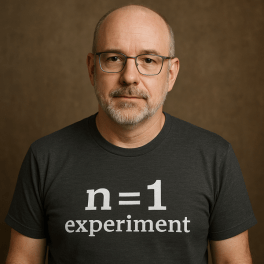
n=1: Living as a Person of Your Time

There’s a strange, powerful truth that often goes unsaid: most of our success, failure, identity, even relevance — is bound to the era in which we’re born.

I was born at a time that happened to align with the rise of the personal computer, the evolution of networking, and the early waves of the Internet. I grew up alongside it. My teenage years were filled with bulletin boards and local area networks, and by the time I entered the workforce, the digital transformation had begun. The timeline fit. The wind was at my back.

Entrepreneurship found me early too. I hit my stride during the explosion of multi-level marketing and the rise of the self-help scene. Those environments — flawed and messy as they were — gave me tools: confidence in public speaking, an understanding of social persuasion, and most of all, a belief that being different could be powerful. Even pro wrestling played its part. It taught me about persona — the value of a character who stands out and leans in.

These experiences weren’t universal. They were specific to my time. My life is a living experiment with a sample size of one — n=1.

ChatGPT Image Sep 24 2025 at 04 14 15 PM


Timeless Wisdom vs. Timely Application

I’ve always had mentors. A supportive family. A spouse who stands by me. And I’ve drawn heavily from Stoicism and spiritual teachings that have endured for centuries. But I don’t mistake timeless wisdom for universal utility.

What worked for Marcus Aurelius or even my own mentors doesn’t always work herenow, for me. That’s why nearly every major move I’ve made — in business, in life — has been driven by experimentation. Scientific method. Trial and error. Observing, adjusting, iterating. Always adjusting for context.

I hunt for asymmetry: small bets with big upsides. And I often use a barbell strategy — thank you, Ray Dalio — allocating the bulk of my resources into stable, known returns while reserving the rest for moonshots. Life, like any investment portfolio, is about managing risk exposure.

And I do it all as asynchronously as possible. Not just in how I work, but in how I think. Time is a tool. I refuse to be trapped by the tyranny of the immediate.


Lessons That Don’t Translate

If I had been born twenty years earlier, I might have missed the digital wave entirely. Or maybe I would have found a different current — maybe mainframes or military networks. If I were born twenty years later, I might have missed the golden age of early web entrepreneurship, but perhaps mobile and app ecosystems would have taken its place.

That’s the point. What worked for me worked because of my timeline. But it might not work for anyone else — even if it looks appealing from the outside.

That’s why I’m cautious about what I try to pass on. I don’t offer a playbook. I offer tools. Mental models. Systems thinking. Frameworks that others can adapt and test for themselves. And I encourage every single person to apply n=1 experimentation to those tools. Because the context in which you live matters just as much — or more — than the tool you use.


Legacy Without Monuments

When my time is up, I don’t need monuments. I’m not chasing statues or street names.

What I do hope for is simpler, quieter. I hope that others see my life as one lived with compassion, generosity, and love. I hope they learn from what I’ve tried, and test those learnings against their own lives. I hope they make better decisions, kinder impacts, smarter plays.

I hope they live their own n=1 experiment, tuned to their time, their truth.

Because the only real legacy is what echoes forward in the lives of others — not through imitation, but through adaptation.


* AI tools were used as a research assistant for this content, but human moderation and writing are also included. The included images are AI-generated.

From Tomorrow to Today: Making Futurism Tangible in Your Daily Routine

Futurism often feels like an ethereal daydream—grand, inspiring, but distant. Bold predictions about 2040 stir our imaginations, yet they rarely map into our Monday mornings. Here at notquiterandom.com, I’m proposing a subtle shift: what if we harness those futuristic visions and anchor them in our 2025 daily habits? This is practical futurism in action—turning forecasts into small, meaningful steps we can take now.

Idea


The Disconnect: Why Futurism Feels Abstract

  • Futurism often lives in abstraction: TED talks and futurology books project us forward—yet too often, they’re unmoored from our present experiences.

  • Technology predictions feel lofty, not livable: We talk AI, distributed computing, or extended reality—but rarely consider how they’ll shape our morning routines, grocery runs, or mid-day breaks in the near term.

  • Audience craving near-term relevance: Tech-savvy professionals, committed yet pragmatic, want today’sutility—not just speculation about 2040.


What’s Missing: Bridging Forecast with Habit

The gap lies in translation—how do we take big-picture forecasts and convert them into rational, actionable daily practices? It’s not enough to know that “AI will transform everything”—we need to know how it can help us, say, stop overthinking, streamline our routines, or fuel better decision-making today.


Learning from Others: What Works, and Why It’s Still Too Vague

  • Future-self mentoring: A Medium article suggests asking your “future self” for advice—pragmatic, reflective, and personal.

  • Habit stacking for incremental change: Insert new habits into existing ones—an early morning walk after brushing your teeth, for instance.

  • AI as daily assistant: From summarizing Zoom calls to smart recipe creation, these are mini-futures we can live now.

But even these are one-offs rather than a cohesive method. What if there were a structured approach for individuals to act on futurism—not tomorrow, but today?


Core Pillars: Building Practical Futures in 2025

1. Flip 2040 Predictions into 2025 Micro-Actions

Take a prediction—say, “AI-enabled personalization everywhere by 2040”—and turn it into steps:

  • Experiment with AI tools that tailor your workout or meal plan (like those that adapt to mood or leftovers).

  • Automate a routine task you dread—like using AI to summarize meetings.
    These are small bets that reflect future trends in digestible chunks for today.

2. Scenario Planning—For You, Not Just Companies

Rather than corporate foresight, create a mini “personal scenario plan”:

  • Optimistic 2025: AI helps you shave hours off your weekday.

  • Constrained 2025: Tight budgets—but you rely on low-cost hacks and habit stacks.

  • Hybrid 2025: A mix—automated routines and soulful analog rituals share your day.
    Plan habits that thrive in each scenario.

3. The “Small Bets” Approach

Reed habit stacking into futurism:

  • Choose one futuristic habit (e.g., AI-curated learning podcast during walks).

  • Run a low-stakes trial—maybe one week.

  • Reflect: Did it help? Discard, tweak, or embed.
    This mimics how entrepreneurs iterate and adapts futurism into a manageable experiment.


Illustrative Mini-Plan: Futurism Meets the Morning Routine

  1. Habit Stack: After brushing teeth, open AI habit tracker that suggests personalized micro-tasks (breathing, brief learning, stand-up stretch).

  2. Try the 2-Minute Trick: Commit to two minutes of something high-tech or future-oriented—like checking that AI tracker—then see if you naturally continue.

  3. Future-Self Check-In: End the day by journaling a quick note: “If I were living in 2040, how would my present behavior differ?”

These micro-actions fuse futurism with routine, making tomorrow’s edge realities feel like tomorrow’s baseline.


Why It Resonates with notquiterandom Readers

Our audience—rooted in tech awareness, skeptical optimism, and personal agency—wants integrity, not hype. This blend of grounded futurism and reflective practice aligns with:

  • Professional curiosity

  • Self-directed experimentation

  • Meaningful progress framed as actionable—no grand leaps, just deliberate stepping stones


Conclusion: Begin Your 2025 Future Habit

The future doesn’t have to be a distant horizon—it can be woven into your habits now. Start small. Let habit stacking, mini-scenarios, and future-self reflection guide you. Over time, these microscale engagements seed long-term adaptability and readiness.


Your Turn

Ready to design your first micro-bet? Whether it’s a futuristic habit stack, an AI tool tryout, or a scenario exercise, share your experiment. Let’s co-create real futures, one habit at a time.

Supporting My Work

If you found this useful and want to help support my ongoing research into the intersection of cybersecurity, automation, and human-centric design, consider buying me a coffee:

👉 Support on Buy Me a Coffee


* AI tools were used as a research assistant for this content, but human moderation and writing are also included. The included images are AI-generated.

The Coming Collision of Quantum, AI, and Blockchain

I’ve been spending a lot of time lately thinking about what happens when three of the most disruptive technologies on our radar—quantum computing, artificial intelligence, and blockchain—don’t just mature, but collide. Not in isolation, not as separate waves of change, but as a single force of transformation. I’ve come to believe this collision may alter our global systems more profoundly than the Internet ever did, and even more than AI is doing on its own today.

ChatGPT Image Sep 3 2025 at 04 08 19 PM

More Than the Sum of the Parts

Each of these technologies is already disruptive. Quantum promises computational power orders of magnitude beyond anything we can imagine today. AI is rapidly reshaping how we create, work, and decide. Blockchain has redefined ownership, trust, and verification.

But imagine them intertwined. AI powered by quantum computing. Identities and financial transactions rooted in shared blockchains, public and private. Blockchain as the arbiter of identity, of non-repudiation, of who we are and what we’ve agreed to. Smart contracts enhanced by AI that can generate, adjust, and arbitrate terms on the fly. Quantum cryptography woven into blockchains that operate at scales and speeds impossible with today’s systems. AI itself acting as the oracle for contracts, feeding real-time insights into automated agreements.

That’s not incremental progress—that’s tectonic shift.

Systems That Won’t Survive the Collision

Some sectors will feel the tremors first. Finance is obvious, even without the collision. Add in these forces together and you have leverage points that could reset the foundations of how money moves, how markets behave, and how trust is established.

Healthcare, defense, and governance won’t look the same either. Identity frameworks built on quantum-secure blockchains could redefine everything from medical records to voting. Critical infrastructure may evolve to the point where the old approaches don’t make sense anymore—financially, socially, or technologically.

And overlay it all with quantum AI: an intelligence capable of holding vast landscapes of knowledge and spinning out probable solutions to nearly any problem, no matter the complexity. That’s not science fiction—it’s a future horizon. Maybe not tomorrow, maybe not in five years, but possibly in my lifetime.

The Double-Edged Sword

I’m not naive about the risks. All swords cut both ways. Bad actors will find ways to exploit these systems. Tyranny won’t vanish, even in a world of shared prosperity. People are driven by power, and that’s unlikely to change.

But the upside is massive. For emerging economies especially, these collisions could level the field, bringing access, transparency, and efficiency that the old systems have long denied. If global prosperity rises, maybe some incentives for malicious behavior diminish.

Early Sparks and Long Horizons

We’ll see hints and echoes of this in the next decade. Experiments, prototypes, niche applications that give us glimpses of the possible. But the real shifts, the agricultural-revolution-scale changes, may sit 20 to 30 years out. If that horizon holds true, the world my grandchildren inherit will be unrecognizable in ways both challenging and awe-inspiring.

Looking Ahead

I don’t claim to have the answers. What I have is a sense that the collision of quantum, AI, and blockchain is not just coming—it’s inevitable. And when it hits, it will be bigger than the sum of the parts. Bigger than the Internet. Maybe even bigger than the scientific revolution itself.

For now, the best we can do is pay attention, experiment responsibly, and prepare ourselves for a future where the unimaginable becomes the baseline.

Supporting My Work

If you found this useful and want to help support my ongoing research into the intersection of cybersecurity, automation, and human-centric design, consider buying me a coffee:

👉 Support on Buy Me a Coffee


* AI tools were used as a research assistant for this content, but human moderation and writing are also included. The included images are AI-generated.

Navigating Rapid Automation & AI Without Losing Human-Centric Design

Why Now Matters

Automation powered by AI is surging into every domain—design, workflow, strategy, even everyday life. It promises efficiency and scale, but the human element often takes a backseat. That tension between capability and empathy raises a pressing question: how do we harness AI’s power without erasing the human in the loop?

A man with glasses performing an audit with careful attention to detail with an office background cinematic 8K high definition photograph

Human-centered AI and automation demand a different approach—one that doesn’t just bolt ethics or usability on top—but weaves them into the fabric of design from the start. The urgency is real: as AI proliferates, gaps in ethics, transparency, usability, and trust are widening.


The Risks of Tech-Centered Solutions

  1. Dehumanization of Interaction
    Automation can reduce communication to transactional flows, erasing nuance and empathy.

  2. Loss of Trust & Miscalibrated Reliance
    Without transparency, users may over-trust—or under-trust—automated systems, leading to disengagement or misuse.

  3. Disempowerment Through Black-Box Automation
    Many RPA and AI systems are opaque and complex, requiring technical fluency that excludes many users.

  4. Ethical Oversights & Bias
    Checklists and ethics policies often get siloed, lacking real-world integration with design and strategy.


Principles of Human–Tech Coupling

Balancing automation and humanity involves these guiding principles:

  • Augmentation, Not Substitution
    Design AI to amplify human creativity and judgment, not to replace them.

  • Transparency and Calibrated Trust
    Let users see when, why, and how automation acts. Support aligned trust, not blind faith.

  • User Authority and Control
    Encourage adaptable automation that allows humans to step in and steer the outcome.

  • Ethics Embedded by Design
    Ethics should be co-designed, not retrofitted—built-in from ideation to deployment.


Emerging Frameworks & Tools

Human-Centered AI Loop

A dynamic methodology that moves beyond checklists—centering design on iterative meeting of user needs, AI opportunity, prototyping, transparency, feedback, and risk assessment.

Human-Centered Automation (HCA)

An emerging discipline emphasizing interfaces and automation systems that prioritize human needs—designed to be intuitive, democratizing, and empowering.

ADEPTS: Unified Capability Framework

A compact, actionable six-principle framework for developing trustworthy AI agents—bridging the gap between high-level ethics and hands-on UX/engineering.

Ethics-Based Auditing

Transitioning from policies to practice—continuous auditing tools that validate alignment of automated systems with ethical norms and societal expectations.


Prototypes & Audit Tools in Practice

  • Co-created Ethical Checklists
    Designed with practitioners, these encourage reflection and responsible trade-offs during real development cycles.

  • Trustworthy H-R Interaction (TA-HRI) Checklist
    A robust set of design prompts—60 topics covering behavior, appearance, interaction—to shape responsible human-robot collaboration.

  • Ethics Impact Assessments (Industry 5.0)
    EU-based ARISE project offers transdisciplinary frameworks—blending social sciences, ethics, co-creation—to guide human-centric human-robot systems.


Bridging the Gaps: An Integrated Guide

Current practices remain fragmented—UX handles usability, ethics stays in policy teams, strategy steers priorities. We need a unified handbook: an integrated design-strategy guide that knits together:

  • Human-Centered AI method loops

  • Adaptable automation principles

  • ADEPTS capability frameworks

  • Ethics embedded with auditing and assessment

  • Prototyping tools for feedback and trust calibration

Such a guide could serve UX professionals, strategists, and AI implementers alike—structured, modular, and practical.


What UX Pros and Strategists Can Do Now

  1. Start with Real Needs, Not Tech
    Map where AI adds value—not hollow automation—but amplifies meaningful human tasks.

  2. Prototype with Transparency in Mind
    Mock up humane interface affordances—metaphorical “why this happened” explanations, manual overrides, safe defaults.

  3. Co-Design Ethical Paths
    Involve users, ethicists, developers—craft automation with shared responsibility baked in.

  4. Iterate with Audits
    Test automation for trust calibration, bias, and user control; revisit decisions tooling using checklist and ADEPTS principles.

  5. Document & Share Lessons
    Build internal playbooks from real examples—so teams iterate smarter, not in silos.


Final Thoughts: Empowered Humans, Thoughtful Machines

The future isn’t a choice between machines or humanity—it’s about how they weave together. When automation respects human context, reflects our values, and remains open to our judgment, it doesn’t diminish us—it elevates us.

Let’s not lose the soul of design in the rush to automate. Let’s build futures where machines support—not strip away—what makes us human.


References


Support My Work

If you found this useful and want to help support my ongoing research into the intersection of cybersecurity, automation, and human-centric design, consider buying me a coffee:

👉 Support on Buy Me a Coffee


* AI tools were used as a research assistant for this content, but human moderation and writing are also included. The included images are AI-generated.

The Second Half: Building a Legacy of Generational Knowledge

“Build, establish, and support a legacy of knowledge that not only exceeds my lifetime, but exceeds generations and creates a generational wealth of knowledge.”

That’s the mission I’ve set for the second half of my life. It’s not about ego, and it’s certainly not about permanence in the usual sense. It’s about creating something that can outlast me—not in the form of statues or plaques, but in the ripples of how people think, solve problems, and support each other long after I’m gone.

ChatGPT Image Aug 2 2025 at 04 04 22 PM

Three Pillars of a Legacy

There are three key prongs to how I’m approaching this mission. Each one is interwoven with a sense of service and intention. The first is about altruism—specifically, applying a barbell strategy to how I support systems and organizations. The middle of the bar is the consistent, proven efforts that deliver value today. But at the ends are the moonshots—projects like the psychedelic science work of MAPS or the long-term frameworks for addressing food insecurity and inequality. These aren’t about tactics; they’re about systems-level, knowledge-driven approaches that could evolve over the next 50 to 100 years.

The second pillar is more personal. It’s about documenting how I think. Inspired in part by Charlie Munger, I’ve come to realize that just handing out solutions isn’t enough. If you want to make lasting impact, you have to teach people how to think. So I’ve been unpacking the models I use—deconstruction, inversion, compounding, Pareto analysis, the entourage effect—and showing how those can be applied across cybersecurity, personal health, and even everyday life. This is less about genius and more about discipline: the practice of solving hard problems with reusable, teachable tools.

The third leg of the stool is mentoring. I don’t have children, but I see the act of mentorship as my version of parenting. I’ve watched people I’ve mentored go on to become rock stars in their own right—building lives and careers they once thought were out of reach. What I offer them isn’t just advice. It’s a commitment to help them design lives they want to live, through systems thinking, life hacking, and relentless self-experimentation.

Confidence and Competence

One of the core ideas I try to pass along—both to myself and to my mentees—is the importance of aligning your circle of confidence with your circle of competence. Let those drift apart, and you’re just breeding hubris. But keep them close, and you cultivate integrity, humility, and effective action. That principle is baked into everything I do now. It’s part of how I live. It’s a boundary check I run daily.

The Long Game

I don’t think legacy is something you “leave behind.” I think it’s something you put into motion and let others carry forward. This isn’t about a monument. It’s about momentum. And if I can contribute even a small part to a future where people think better, solve bigger, and give more—then that’s a legacy I can live with.


* AI tools were used as a research assistant for this content, but human moderation and writing are also included. The included images are AI-generated.