Three Field Guides for the Security Problems Showing Up Right Now

Over the last several months, we have released three longer-form guides around problems we keep seeing in real environments:

  • The Antifragile SOC Book

  • The AI Agents Management Framework

  • The Security Leader’s Operating System

They cover different areas, but they share a common theme: how to operate effectively as complexity, automation, and pressure increase.

Books

Why We Created These Materials

These guides did not begin as content projects.

They came from working problems.

Over the years, we have accumulated a lot of models, processes, questions, and operating approaches that we use when helping organizations solve difficult security problems. Some came from client work, some from research, and plenty came from lessons learned the hard way.

Much of that knowledge lived in conversations, notes, presentations, and experience.

We decided it was time to write more of it down.

Not as theory, and not as another collection of cybersecurity predictions.

As practical field material people can use, challenge, adapt, and apply.

Why Release Them Now?

The timing matters.

Security teams are being asked to handle more data, more tooling, more organizational expectations, and more complexity.

At the same time, AI is moving rapidly from experimentation into real operational workflows.

And security leaders are increasingly being asked to manage all of this while making faster decisions with broader consequences.

The answer cannot simply be to do more.

More alerts. More automation. More dashboards. More meetings. More processes.

What we increasingly need are better operating models.

That is what these three guides are intended to provide.

The Antifragile SOC Book

Most SOCs are very good at generating activity.

The harder question is whether that activity is actually improving security.

The Antifragile SOC Book looks at how security operations can move beyond simply absorbing alerts and incidents toward continuously learning from them.

It is about building a SOC that gets better under pressure, focuses scarce analyst attention where it matters, and treats noise, friction, and failure as signals for improvement.

If you run, manage, or depend on a SOC, this one is for you.

Download The Antifragile SOC Book:

https://media.microsolved.com/The_Antifragile_SOC_Book.pdf

The AI Agents Management Framework

AI agents are quickly moving from interesting experiments into systems that can retrieve data, use tools, trigger workflows, and take action.

That creates a new management problem.

The AI Agents Management Framework is built around a simple idea: once an AI agent can act on behalf of the organization, it should be governed more like a digital worker than a traditional application.

The guide provides a practical way to think about ownership, authority, access, monitoring, risk, and accountability as agents become more capable.

If your organization is deploying agents beyond simple chat interfaces, now is the time to think about how they will be managed.

Get the AI Agents Management Framework:

https://signup.microsolved.com/ai-management-e-book/

The Security Leader’s Operating System

The third guide is the most personal.

Capable security leaders tend to attract work.

Eventually, incidents, exceptions, decisions, meetings, escalations, and unfinished problems can consume all of the time that was supposed to be used for leadership.

The Security Leader’s Operating System captures the approach I use to decide what should disappear, what should move to someone else, what should be simplified, what should be automated, and what genuinely deserves a leader’s attention.

It is not another productivity system for processing an infinite queue faster.

It is about redesigning the queue.

If you are a security leader who has become the default destination for every difficult problem, this one may be the most useful of the three.

Download The Security Leader’s Operating System:

https://media.microsolved.com/The_Security_Leaders_Operating_System.pdf

The Common Thread

I did not originally think of these as a series.

But they keep converging on the same questions.

Where should human attention go?

What should we automate?

What should remain under human judgment?

How do we distinguish useful outcomes from simple activity?

And how do we build systems that improve instead of merely accumulating more work?

Those questions are becoming more important as AI and automation make it easier to do more things, faster.

The challenge is no longer just whether something can be done.

It is deciding what is worth doing.

That is why we are releasing these materials now.

If one of these problems is showing up in your organization, grab the relevant guide, read it, challenge it, and put something from it into practice.

The Antifragile SOC Book
https://media.microsolved.com/The_Antifragile_SOC_Book.pdf

The AI Agents Management Framework
https://signup.microsolved.com/ai-management-e-book/

The Security Leader’s Operating System
https://media.microsolved.com/The_Security_Leaders_Operating_System.pdf

Use what works.

Discard what does not.

And, ideally, make the system better.


* AI tools were used as a research assistant for this content, but human moderation and writing are also included. The included images are AI-generated.

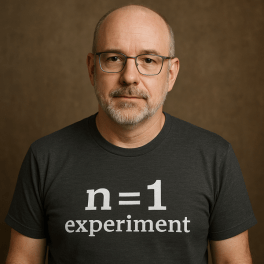
n=1: Living as a Person of Your Time

There’s a strange, powerful truth that often goes unsaid: most of our success, failure, identity, even relevance — is bound to the era in which we’re born.

I was born at a time that happened to align with the rise of the personal computer, the evolution of networking, and the early waves of the Internet. I grew up alongside it. My teenage years were filled with bulletin boards and local area networks, and by the time I entered the workforce, the digital transformation had begun. The timeline fit. The wind was at my back.

Entrepreneurship found me early too. I hit my stride during the explosion of multi-level marketing and the rise of the self-help scene. Those environments — flawed and messy as they were — gave me tools: confidence in public speaking, an understanding of social persuasion, and most of all, a belief that being different could be powerful. Even pro wrestling played its part. It taught me about persona — the value of a character who stands out and leans in.

These experiences weren’t universal. They were specific to my time. My life is a living experiment with a sample size of one — n=1.

ChatGPT Image Sep 24 2025 at 04 14 15 PM


Timeless Wisdom vs. Timely Application

I’ve always had mentors. A supportive family. A spouse who stands by me. And I’ve drawn heavily from Stoicism and spiritual teachings that have endured for centuries. But I don’t mistake timeless wisdom for universal utility.

What worked for Marcus Aurelius or even my own mentors doesn’t always work herenow, for me. That’s why nearly every major move I’ve made — in business, in life — has been driven by experimentation. Scientific method. Trial and error. Observing, adjusting, iterating. Always adjusting for context.

I hunt for asymmetry: small bets with big upsides. And I often use a barbell strategy — thank you, Ray Dalio — allocating the bulk of my resources into stable, known returns while reserving the rest for moonshots. Life, like any investment portfolio, is about managing risk exposure.

And I do it all as asynchronously as possible. Not just in how I work, but in how I think. Time is a tool. I refuse to be trapped by the tyranny of the immediate.


Lessons That Don’t Translate

If I had been born twenty years earlier, I might have missed the digital wave entirely. Or maybe I would have found a different current — maybe mainframes or military networks. If I were born twenty years later, I might have missed the golden age of early web entrepreneurship, but perhaps mobile and app ecosystems would have taken its place.

That’s the point. What worked for me worked because of my timeline. But it might not work for anyone else — even if it looks appealing from the outside.

That’s why I’m cautious about what I try to pass on. I don’t offer a playbook. I offer tools. Mental models. Systems thinking. Frameworks that others can adapt and test for themselves. And I encourage every single person to apply n=1 experimentation to those tools. Because the context in which you live matters just as much — or more — than the tool you use.


Legacy Without Monuments

When my time is up, I don’t need monuments. I’m not chasing statues or street names.

What I do hope for is simpler, quieter. I hope that others see my life as one lived with compassion, generosity, and love. I hope they learn from what I’ve tried, and test those learnings against their own lives. I hope they make better decisions, kinder impacts, smarter plays.

I hope they live their own n=1 experiment, tuned to their time, their truth.

Because the only real legacy is what echoes forward in the lives of others — not through imitation, but through adaptation.


* AI tools were used as a research assistant for this content, but human moderation and writing are also included. The included images are AI-generated.

How Running a BBS Shaped My Path in Information Security

Today, I want to share with you how my early experiences with Magick Mountain BBS laid the foundation for my career in information security and my role at MicroSolved.

80sIBM

It all started in the late 80s when my fascination with telecommunications and the allure of digital communication systems led me to discover the world of Bulletin Board Systems (BBS). By 1989, I had launched Magick Mountain BBS, a platform that began as a simple operation on an IBM PC clone and evolved into a sophisticated network on an Amiga 500, serving a bustling community interested in everything from programming to hacking.

Running Magick Mountain was like stepping into a new world where information was at our fingertips, albeit not as seamlessly as it is today with the internet. This was a world where modems connected curious minds, and every conversation could spark an idea. The BBS hosted discussions on a myriad of topics, from technology to social issues, and became a central hub for like-minded individuals to connect and share knowledge.

The technical challenges were significant. Setting up and maintaining the BBS required a deep understanding of hardware and software. I juggled DOS systems, dealt with dual floppy setups, and later navigated the complexities of Amiga OS. Each upgrade taught me resilience and the importance of staying current with technological advances, skills that are crucial in the ever-evolving field of cybersecurity.

But what truly shaped my career was the community management aspect. Magick Mountain was more than just a platform; it was a community. Managing this community taught me the delicate balance of fostering open communication while ensuring a safe environment—paralleling the core challenges of modern cybersecurity.

These early experiences honed my skills in handling sensitive information and spotting vulnerabilities, paving the way for my transition into the corporate world. They ingrained in me a hacker’s mindset of curiosity and pragmatism, which later became instrumental in founding MicroSolved in 1992. Here, I applied the lessons learned from BBS days to real-world information security challenges, helping businesses protect themselves against cyber threats.

Reflecting on the evolution from BBS to today’s digital ecosystems, the principles of community building, knowledge exchange, and security management remain as relevant as ever. These principles guide our work at MicroSolved, as we navigate the complexities of protecting enterprise systems in an interconnected world.

To those aspiring to make a mark in cybersecurity, my advice is to nurture your curiosity. Dive deep into technology, join communities, share your knowledge, and keep pushing the boundaries. The digital world is vast, and much like the BBS days, there’s always something new on the horizon.

Thank you for reading. I hope my journey from running a BBS to leading a cybersecurity firm inspires you to pursue your passions and explore the endless possibilities in the digital realm.


*AI was used in the creation of this content. It created the final draft based on a series of interviews and Q&A sessions with an AI engine. All content is true and based on my words and ideas in those interviews and Q&A sessions.