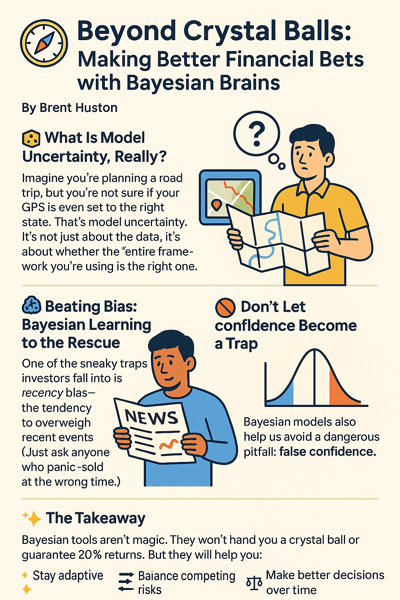
🧭 Beyond Crystal Balls: Making Better Financial Bets with Bayesian Brains


If you’ve ever wondered whether your financial model might be more fiction than forecast, you’re not alone. 🌀 We’ve all built (or trusted) a model that felt solid—until the market laughed in its face. Turns out, model uncertainty is one of the biggest blind spots in finance.

Luckily, Bayesian methods don’t just shine a flashlight into the dark—they help map the cave while you’re in it. Let’s talk about why that matters.

Infograph060925 2

đŸŽČ What Is Model Uncertainty, Really?

Imagine you’re planning a road trip, but you’re not sure if your GPS is even set to the right state. That’s model uncertainty. It’s not just about the data, it’s about whether the entire framework you’re using is the right one.

In finance, this shows up when:

* Your model assumes a normal distribution, but reality goes fat-tailed 📉
*You pick the “wrong” factors in your investment model
*Policy or market dynamics shift so fast your model gets stale
Bayesian approaches handle this by saying: “Why pick one model when you can blend several?” Using Bayesian model averaging, you don’t bet on a single winner—you weigh your bets across multiple contenders, each with their own probability.

🧠 Beating Bias: Bayesian Learning to the Rescue

One of the sneaky traps investors fall into is recency bias—the tendency to overweigh recent events. (Just ask anyone who panic-sold at the wrong time. đŸ™‹â€â™‚ïž)

Bayesian learning gently reins that in. It updates your beliefs steadily, incorporating new data without tossing out everything that came before.

It’s like the opposite of headline-chasing—it’s strategy based on the full picture.

đŸš« Don’t Let Confidence Become a Trap

Bayesian models also help us avoid a dangerous pitfall: false confidence. Just because a model spits out precise numbers doesn’t mean those numbers are right. Rigid models often fail to account for rare events or black swans.

Bayesian thinking bakes uncertainty right into the math. Instead of saying, “X will happen,” it says, “Here’s the range of what might happen, and how likely each scenario is.” That humility makes for much smarter risk management.

✹ The Takeaway

Bayesian tools aren’t magic. They won’t hand you a crystal ball or guarantee 20% returns. But they will help you:

🔄 Stay adaptive
📊 Balance competing risks
đŸ§© Account for what you don’t know
⚖ Make better decisions over time

In a world where models can deceive and data changes daily, Bayesian thinking is less about finding the perfect answer—and more about asking the right questions.

Stay curious. Question your tools. And never stop updating your beliefs.


Support the creation of high-impact content and research. Sponsorship opportunities are available for specific topics, whitepapers, tools, or advisory insights. Learn more or contribute here: Buy Me A Coffee

* AI tools were used as a research assistant for this content, but human moderation and writing are also included. The included images are AI-generated.

🔍 Taming the Chaos: Bayesian Methods in Real-World Market Mayhem

Let’s face it: markets can be absolute chaos. One day, crypto is mooning 🚀. The next? Your portfolio looks like it fell down an elevator shaft. Whether it’s tech stocks, foreign currencies, or those mysterious private equity plays—uncertainty is the name of the game.

So how do we make sense of the madness? That’s where Bayesian methods shine. Let’s explore how this approach handles messy, real-world investment scenarios in ways that feel more like strategy and less like guesswork.

Infograph060925 1

📉 Tech Stocks: The Volatility Playground

Tech stocks are the drama queens of the financial world—flashy, emotional, and occasionally brilliant. Predicting their behavior is like trying to forecast what your cat will do next. (Spoiler: chaos. đŸ±)

With Bayesian methods, we don’t just cross our fingers and hope. We take what we know (past earnings, macroeconomic data, investor sentiment), and update that with each quarterly report, policy shift, or product launch.

Think of it like a smart thermostat—always learning, adjusting, and optimizing based on the latest readings.

đŸȘ™ Cryptocurrency: Where Rules Go to Die

If tech stocks are drama queens, crypto is the rebellious teenager who ignores curfews and reinvents money while doing it. 📉📈📉📈

Bayesian techniques help us build probabilistic models that can adapt to the wild swings. Instead of betting everything on one model (like “Bitcoin always rebounds”), we average across several plausible views—some bullish, some bearish—based on real-time data.

It’s like having a squad of advisors whispering in your ear instead of just the loudest one at the table.

đŸ’± Foreign Currency: Subtle But Deadly

Foreign currency markets don’t always get the headlines, but wow—can they sneak up on you. From trade wars to interest rate moves, they’re constantly shifting. And if you’re holding investments abroad? You’re automatically playing in this game.

Here, Bayesian methods work wonders by adjusting for spillovers—like how a U.S. Fed move might impact the Euro or Aussie dollar. Bayesian models can detect these effects and shift forecasts accordingly.

They’re like sensitive seismographs for financial tremors you didn’t even know were coming.

🧠 Decision-Making, Upgraded

Traditional models often get stuck in their assumptions—like an old GPS insisting you drive through a lake. Bayesian models say, “Whoa, new data just came in—let’s re-route.”

They help us:

✔Stay flexible in fast-changing conditions
✔Avoid overreacting to noise
✔Balance competing risks intelligently

And yeah, they take a little effort to understand. But trust me—once you see the results, it’s hard to go back.

Next up: In our final post of this series, we’ll dig into how Bayesian methods help tackle one of the biggest hidden risks in finance—model uncertainty. It’s like questioning whether your map is even the right one.

Until then—keep learning, stay skeptical, and treat your beliefs like software: always in beta. đŸ§ đŸ’»


* AI tools were used as a research assistant for this content, but human moderation and writing are also included. The included images are AI-generated.

🧠 Betting on Beliefs: Why Bayesian Thinking Belongs in Your Investment Toolbox

If you’ve ever made an investment decision that felt like a coin toss, welcome to the club. 📉📈 Uncertainty is baked into finance, no matter how many spreadsheets or models we throw at it. But here’s the good news: there’s a smarter way to deal with this unpredictability. It’s called Bayesian thinking—and it’s kind of like upgrading your brain with a statistics-powered GPS for navigating risky terrain.

ThinkingNotes

Let’s unpack this, not as a PhD thesis, but like we’re two old friends talking about the markets over coffee (and maybe some bourbon 🍾 if it’s been that kind of quarter).

What’s Bayesian Thinking Anyway?

Named after Thomas Bayes—a statistician and theologian with a knack for probability—Bayesian thinking is all about updating your beliefs as new data comes in. Imagine you’re sailing a boat in foggy weather. You can’t see much, but every ping from your radar helps you refine your course. That’s Bayesian logic at work: start with a guess (your prior), then update that guess as more info rolls in (your posterior).

In the world of investing, this isn’t just helpful—it’s survival gear.

Why This Matters More Than Ever

Markets today feel like riding a rollercoaster with no seatbelt. From crypto crashes to interest rate whiplash, traditional models often fail to keep up. Bayesian methods thrive in these situations because they:

✅ Incorporate uncertainty (instead of pretending it’s not there)
✅ Constantly learn and adapt as conditions change
✅ Handle model errors and parameter guesswork with more nuance than rigid formulas

In other words, Bayesian tools are like having a financial weatherman who admits they don’t know everything—but gets more accurate every time it rains.

Real Talk: Why I Use This Stuff

Here’s a dirty little secret: no model gets it right all the time. But Bayesian approaches admit that up front. They say, “Hey, let’s not commit to one truth. Let’s explore a bunch of possibilities and adjust as we go.” That humility is powerful. Especially in markets where the only constant is change.

Plus, it fits with how humans actually think. We revise our opinions as we learn—why shouldn’t our investment models do the same?

Final Thought: Don’t Be a Dinosaur 🩕 in a Digital Jungle

If you’re still using old-school statistical tools that ignore uncertainty or can’t adapt on the fly, you’re setting yourself up to get blindsided. Bayesian methods aren’t just for math geeks—they’re for anyone serious about managing risk in the real world.

So next time you’re staring at your portfolio, wondering what the heck just happened, ask yourself this: “What do I believe now, and how should I change my mind based on what I just learned?”

That’s the Bayesian mindset.

Stay adaptive. Stay curious. Stay a little skeptical. And as always—question everything.

Coming up next: we’ll dive into how this plays out with real market chaos—from crypto crashes to the currency jungle. đŸȘ™đŸ’±đŸ“Š


* AI tools were used as a research assistant for this content, but human moderation and writing are also included. The included images are AI-generated.


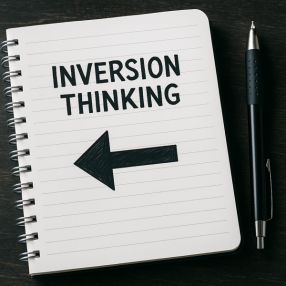
Inversion Thinking: Solving Backward to Live Forward

I’ve always been a fan of breaking things down to figure out how they work—sometimes that means disassembling old electronics, other times it means turning a question on its head. That’s where inversion comes in.

InversionThinking

Inversion is this strange, elegant mental model—popularized by Charlie Munger but rooted in the mathematical mind of Carl Jacobi—built around a simple idea: if you want to solve something, try solving the opposite. Don’t just ask, “How can I succeed?” Ask, “How might I fail?” Then avoid those failures.

This flipped way of thinking has helped me untangle everything from tricky team dynamics to gnarly security architecture. It’s not magic. It’s just honest thinking. And it’s surprisingly useful—in life and cybersecurity.

Everyday Life: Living by Avoiding the Dumb Stuff

In personal productivity, inversion’s like having a brutally honest friend. Don’t ask how to be productive—ask what makes you waste time. Suddenly you’re cancelling useless meetings, setting agendas, trimming the invite list. It’s not about optimizing your calendar, it’s about not being a dumbass with your calendar.

When it comes to tasks, the question isn’t “How do I get more done?” but “What distracts me?” Turns out, for me, it’s that one open browser tab I swear I’ll close later. Close it now.

Even wellness gets better when you flip the lens. Don’t chase the best workout plan—just ask “Why do I skip the gym?” Too far away, crappy equipment, bad timing. Fix those.

Same with food. I stopped keeping junk in plain sight. I eat better now, not because I have more willpower, but because I don’t trip over the Oreos every time I pass the kitchen.

Inversion also made me rethink how I spend money. Don’t ask “How do I save more?” Ask “What makes me blow cash unnecessarily?” That late-night Amazon scroll? Canceled. That gym membership I never use? Gone.

Relationships: Avoiding Trust Bombs

In relationships—especially the ones you care about—you want to build trust. But instead of obsessing over how to build it, ask “What destroys trust?” Lying. Inconsistency. Oversharing someone’s private stuff. Don’t do those things.

Want better communication? Don’t start with strategies. Just stop interrupting, assuming, or trying to fix everything when people just want to be heard.

Cybersecurity: Think Like the Adversary

Now let’s pivot to my day job: security. Inversion is baked into the best security thinking. It’s how I do architecture reviews: don’t ask, “Is this secure?” Ask, “If I were going to break this, how would I do it?”

It’s how I approach resource planning: “What failure would hurt us the most?” Not “Where should we invest?” The pain points reveal your priorities.

Even in incident response, I run pre-mortems: “Let’s assume this defense fails—what went wrong?” It’s bleak, but effective.

Want to design better user behavior? Don’t pile on password rules. Ask “What makes users work around them?” Then fix the root causes. If people hate your training, ask why. Then stop doing the thing that makes them hate it.

The Big Idea: Don’t Try to Be Smart. Just Don’t Be Stupid.

“It is remarkable how much long-term advantage people like us have gotten by trying to be consistently not stupid, instead of trying to be very intelligent.” — Charlie Munger

We don’t need to be clever all the time. We need to stop sabotaging ourselves.

Inversion helps you see the hidden traps. It doesn’t promise easy answers, but it gives you better questions. And sometimes, asking the right wrong question is the smartest thing you can do.

Would love to hear how you’ve used inversion in your own life or work. Leave a note or shoot me an email. Always curious how others are flipping the script.


* AI tools were used as a research assistant for this content, but human moderation and writing are also included. The included images are AI-generated.
 

The Heisenberg Principle, Everyday Life, and Cybersecurity: Embracing Uncertainty

You’ve probably heard of the Heisenberg Uncertainty Principle — that weird quantum physics thing that says you can’t know where something is and how fast it’s going at the same time. But what does that actually mean, and more importantly, how can we use it outside of a physics lab?

Here’s the quick version:
At the quantum level, the more precisely you try to measure the position of a particle (like an electron), the less precisely you can know its momentum (its speed and direction). And vice versa. It’s not about having bad tools — it’s a built-in feature of the universe. The act of observing disturbs the system.

Heis

Now, for anything bigger than a molecule, this doesn’t really apply. You can measure the location and speed of your car without it vanishing into a probability cloud. The effects at our scale are so tiny they’re basically zero. But that doesn’t mean Heisenberg’s idea isn’t useful. In fact, I think it’s a perfect metaphor for both life and cybersecurity.

Here’s how I’ve been applying it:

1. Observation Changes Behavior

In security and in business, watching something often changes how it behaves. Put monitoring software on endpoints, and employees become more cautious. Watch a threat actor closely, and they’ll shift tactics. Just like in quantum physics, observation isn’t passive — it has consequences.

2. Focus Creates Blind Spots

In incident response, zeroing in on a single alert might help you track one bad actor — but you might miss the bigger pattern. Focus too much on endpoint logs and you might miss lateral movement in cloud assets. The more precisely you try to measure one thing, the fuzzier everything else becomes. Sound familiar?

3. Know the Limits of Certainty

The principle reminds us that perfect knowledge is a myth. There will always be unknowns — gaps in visibility, unknown unknowns in your threat model, or behaviors that can’t be fully predicted. Instead of chasing total control, we should optimize for resilience and responsiveness.

4. Think Probabilistically

Security decisions (and life choices) benefit from probability thinking. Nothing is 100% secure or 100% safe. But you can estimate, adapt, and prepare. The world’s fuzzy — accept it, work with it, and use it to your advantage.

Final Thought

The Heisenberg Principle isn’t just for physicists. It’s a sharp reminder that trying to know everything can actually distort the system you’re trying to understand. Whether you’re debugging code, designing a threat detection strategy, or just navigating everyday choices, uncertainty isn’t a failure — it’s part of the system. Plan accordingly.


* AI tools were used as a research assistant for this content, but human moderation and writing are also included. The included images are AI-generated.

Systems Thinking and Mental Models: My Daily Operating System

I’ve been obsessed with systems, optimization, and mental models since my teenage years. Back then, I didn’t label them as such; they were simply routines I developed to make life easier. The goal was straightforward: minimize time spent on tasks I disliked and maximize time for what I loved. This inclination naturally led me to the hacker mentality, further nurtured by the online BBS culture. Additionally, my engagement with complex RPGs and tabletop games like Dungeons and Dragons honed my attention to detail
and instilled a step-by-step methodological approach to problem-solving. Over time, these practices seamlessly integrated
into both my professional and personal life.


MyModels

Building My Daily Framework

My days are structured around a concept I call the “Minimum Viable Day.” It’s about identifying the essential tasks that,
if accomplished, make the day successful. To manage tasks and projects, I employ a variant of the Eisenhower Matrix that I coded for myself in Xojo. This matrix helps me prioritize based on urgency and importance.

Each week begins with a comprehensive review of the past week, followed by a MATTO (Money, Attention, Time, Turbulence, Opportunity)
analysis for the upcoming week. This process ensures I allocate my resources effectively. I also revisit my “Not To Do List,”
a set of personal guidelines to keep me focused and avoid common pitfalls. Examples include:

  • Don’t be a soldier; be a general—empower the team to overcome challenges.
  • Avoid checking email outside scheduled times.
  • Refrain from engaging in inane arguments.
  • Before agreeing to something, ask, “Does this make me happy?”

Time-blocking is another critical component. It allows me to dedicate specific periods to tasks and long-term projects,
ensuring consistent progress.

Mental Models in Action

Throughout my day, I apply various mental models to enhance decision-making and efficiency:

  • EDSAM: Eliminate, Delegate, Simplify, Automate, and Maintain—my approach to task management.
  • Pareto Principle: Focusing on the 20% of efforts that yield 80% of results.
  • Occam’s Razor: Preferring simpler solutions when faced with complex problems, and looking for the path with the least assumptions.
  • Inversion: Considering what I want to avoid to understand better what I want to achieve.
  • Compounding: Recognizing that minor, consistent improvements lead to significant long-term gains.

These models serve as lenses through which I view challenges, ensuring that my actions are timely, accurate, and valuable.

Teaching and Mentorship

Sharing these frameworks with others has become a significant focus in my life. I aim to impart these principles through content creation and mentorship, helping others develop their own systems and mental models. It’s a rewarding endeavor to watch mentees apply these concepts to navigate their paths more effectively.

The Power of Compounding

If there’s one principle I advocate for everyone to adopt, it’s compounding. Life operates as a feedback loop: the energy and actions you invest return amplified. Invest in value, and you’ll receive increased value; invest in compassion, and kindness will follow. Each decision shapes your future, even if the impact isn’t immediately apparent. By striving to be a better version of myself daily and optimizing my approaches, I’ve witnessed the profound effects of this principle.

Embracing systems thinking and mental models isn’t just about efficiency; it’s about crafting a life aligned with your values and goals.
By consciously designing our routines and decisions, we can navigate complexity with clarity and purpose.


* AI tools were used as a research assistant for this content, but human moderation and writing are also included. The included images are AI-generated.

MATTO: A Lens for Measuring the True Cost of Anything

Every decision you make comes with a price — but the real cost isn’t always just dollars and cents. That’s where MATTO comes in.

Matto

MATTO stands for Money, Attention, Time, Turbulence, and Opportunity. It’s a framework I’ve been using for years to evaluate whether a new project, commitment, or hobby is worth taking on. Think of it as a currency-based lens for life. Every undertaking has a cost, and it usually extracts something from each of these currencies — whether you’re consciously tracking it or not.

Here’s how I use MATTO to make better decisions, avoid burnout, and keep my energy focused on what truly matters.

M is for Money

This one’s the easiest to calculate, but often the most misleading if taken in isolation. The money cost is the actual financial impact of the thing you’re considering. Will you need to buy equipment, software, or services? Are there recurring costs? What’s the long-term spend?

Say I want to pick up kayaking. The money cost isn’t just the kayak — it’s the paddle, the roof rack, the life vest, the boat registration, and probably a few “surprise” purchases along the way. I always ask: is the spend worth the return to me?

A is for Attention

This one’s sneakier. Attention is a currency that only time or sleep can replenish. So, I guard it carefully.

Attention cost is about the mental load. How much new information will I have to absorb? How much learning is required? Will I need to spend weeks ramping up before I can even begin to enjoy it?

With a work project, I ask: How much new thinking will this require? Can I apply any adjacent skills to make it easier? Am I likely to fail forward, or is this going to drain my headspace and leave me exhausted?

I usually rate attention cost as high, medium, or low — and I take that rating seriously.

T is for Time

This isn’t about how mentally demanding something is — it’s about your calendar. How many hours or days will this take? How much of my lifespan and healthspan am I willing to spend here?

Time is the only currency you can’t earn back.

Personally, I block out time for everything. So when I’m considering something new, I ask: how many of my time blocks will it require? Are those blocks available? And if I spend them here, what won’t get done?

For kayaking: Will I actually get out on the water, or will the kayak gather dust in the garage because I overestimated my free weekends?

T is for Turbulence

Turbulence is the emotional and interpersonal chaos a project might introduce.

Will this bring drama into my life? Will I be working with people I enjoy, or people who drain me? Will it interrupt my routines or interfere with other commitments? Will it stress me out, or cause strain with family and friends?

A high-turbulence project might technically be a “good opportunity,” but if it leaves me exhausted, irritated, or distant from my loved ones — it’s probably not worth it.

O is for Opportunity

Every “yes” is a “no” to something else. That’s the law of opportunity cost.

So I ask: If I say yes to this, what am I saying no to? What other opportunities am I cutting off? Is there something with a higher ROI — whether in satisfaction, growth, or future flexibility — that I’m neglecting?

Sometimes, the opportunity gained outweighs all the other costs. Sometimes, the opportunity lost is a dealbreaker. It’s a tradeoff every time — and I try to make that tradeoff with eyes wide open.

MATTO in the Real World

Using the MATTO framework doesn’t mean I always make the perfect decision. But it does help me make intentional ones.

Whether I’m picking up a new hobby, saying yes to a consulting gig, or deciding whether to join a new team, I run it through the MATTO lens. I look at what each currency will cost me and whether that investment aligns with my values and current priorities.

Sometimes, the price is worth it. Sometimes, it’s not.

Either way, I walk in with clarity — and more often than not, that makes all the difference.


The Huston Approach to Knowledge Management: A System for the Curious Mind

I’ve always believed that managing knowledge is about more than just collecting information—it’s about refining, synthesizing, and applying it. In my decades of work in cybersecurity, business, and technology, I’ve had to develop an approach that balances deep research with practical application, while ensuring that I stay ahead of emerging trends without drowning in information overload.

KnowledgeMgmt

This post walks through my knowledge management approach, the tools I use, and how I leverage AI, structured learning, and rapid skill acquisition to keep my mind sharp and my work effective.

Deep Dive Research: Building a Foundation of Expertise

When I need to do a deep dive into a new topic—whether it’s a cutting-edge security vulnerability, an emerging AI model, or a shift in the digital threat landscape—I use a carefully curated set of tools:

  • AI-Powered Research: ChatGPT, Perplexity, Claude, Gemini, LMNotebook, LMStudio, Apple Summarization
  • Content Digestion Tools: Kindle books, Podcasts, Readwise, YouTube Transcription Analysis, Evernote

The goal isn’t just to consume information but to synthesize it—connecting the dots across different sources, identifying patterns, and refining key takeaways for practical use.

Trickle Learning & Maintenance: Staying Current Without Overload

A key challenge in knowledge management is not just learning new things but keeping up with ongoing developments. That’s where trickle learning comes in—a lightweight, recurring approach to absorbing new insights over time.

  • News Aggregation & Summarization: Readwise, Newsletters, RSS Feeds, YouTube, Podcasts
  • AI-Powered Curation: ChatGPT Recurring Tasks, Bayesian Analysis GPT
  • Social Learning: Twitter streams, Slack channels, AI-assisted text analysis

Micro-Learning: The Art of Absorbing Information in Bite-Sized Chunks

Sometimes, deep research isn’t necessary. Instead, I rely on micro-learning techniques to absorb concepts quickly and stay versatile.

  • 12Min, Uptime, Heroic, Medium, Reddit
  • Evernote as a digital memory vault
  • AI-assisted text extraction and summarization

Rapid Skills Acquisition: Learning What Matters, Fast

There are times when I need to master a new skill rapidly—whether it’s understanding a new technology, a programming language, or an industry shift. For this, I combine:

  • Batch Processing of Content: AI analysis of YouTube transcripts and articles
  • AI-Driven Learning Tools: ChatGPT, Perplexity, Claude, Gemini, LMNotebook
  • Evernote for long-term storage and retrieval

Final Thoughts: Why Knowledge Management Matters

The world is overflowing with information, and most people struggle to make sense of it. My knowledge management system is designed to cut through the noise, synthesize insights, and turn knowledge into action.

By combining deep research, trickle learning, micro-learning, and rapid skill acquisition, I ensure that I stay ahead of the curve—without burning out.

This system isn’t just about collecting knowledge—it’s about using it strategically. And in a world where knowledge is power, having a structured approach to learning is one of the greatest competitive advantages you can build.

You can download a mindmap of my process here: https://media.microsolved.com/Brent’s%20Knowledge%20Management%20Updated%20031625.pdf


* AI tools were used as a research assistant for this content.


The Mental Models of Smart Travel: Planning and Packing Without the Stress


Travel is one of those things that can be thrilling, exhausting, frustrating, and enlightening all at once.
The way we approach planning and packing can make the difference between a seamless adventure and a stress-fueled disaster.
Over the years, I’ve developed a set of mental models that help take the chaos out of travel—whether for work, leisure, or a bit of both.

Travel

Here are the most useful mental models I rely on when preparing for a trip.

1. The Inversion Principle: Pack for the Worst, Plan for the Best

The Inversion Principle comes from the idea of thinking backward: instead of asking, “What do I need?”, ask
“What will ruin this trip if I don’t have it?”

  • Weather disasters – Do you have the right clothing for unexpected rain or temperature drops?
  • Tech failures – What’s your backup plan if your phone dies or your charger fails?
  • Health issues – Are you prepared for illness, minor injuries, or allergies?

For planning, inversion means preparing for mishaps while assuming that things will mostly go well.
I always have a rough itinerary but leave space for spontaneity.

2. The Pareto Packing Rule: 80% of What You Pack Won’t Matter

The Pareto Principle (80/20 Rule) states that 80% of results come from 20% of efforts. In travel, this means:

  • 80% of the time, you’ll wear the same 20% of your clothes.
  • 80% of your tech gear won’t see much use.
  • 80% of the stress comes from overpacking.

3. The MVP (Minimum Viable Packing) Approach

Inspired by the startup world’s concept of a Minimum Viable Product, this model asks: “What’s the absolute minimum I need for this trip to work?”

4. The Rule of Three: Simplifying Decisions

When faced with too many choices, the Rule of Three keeps decision-making simple. Apply it to:

  • Clothing – Three tops, three bottoms, three pairs of socks/underwear.
  • Shoes – One for walking, one for casual/dress, and one for special activities.
  • Daily Carry Items – If it doesn’t fit in your three most-used pockets or compartments, rethink bringing it.

5. The Anti-Fragile Itinerary: Build in Buffer Time

Nassim Taleb’s concept of antifragility (things that gain from disorder) applies to travel.

6. The “Two-Week” Packing Test

A great test for overpacking is to ask: “If I had to live out of this bag for two weeks, would it work?”

7. The “Buy It There” Mindset

Instead of cramming my bag with “what-ifs,” I ask: “If I forget this, can I replace it easily?” If yes, I leave it behind.

Wrapping Up: Travel Lighter, Plan Smarter

The best travel experiences come when you aren’t burdened by too much stuff or too rigid a schedule.
Next time you’re packing for a trip, try applying one or two of these models. You might find yourself traveling lighter,
planning smarter, and enjoying the experience more.

What are your go-to mental models for travel? Drop a comment on Twitter or Mastodon (@lbhuston)—I’d love to hear them!


* AI tools were used as a research assistant for this content.