Modern deeptech investing often feels like groping in the dark. You’re not simply picking winners — you’re modeling futures, coping with extreme nonlinearity, and forcing structure on chaos. The research I’ve conducted in this area has been revealing. Below, I reflect on it, extend a few ideas, and flesh out how one might operationalize it in a venture or research‑lab context.

A. The Core Logic: Inputs → Levers → Outputs
At the heart of the structure is a clean mapping:
-
Inputs: budget, time horizon, risk tolerance, domain constraints, and a pipeline of opportunities.
-
Levers: probability calibration, tranche sizing (how much per bet), stage gating, diversification, optionality.
-
Outputs: expected value (EV), EV density (time‑adjusted), capital at risk, downside bounds, and the resulting portfolio mix.
That’s beautiful. It forces you to treat capital as fungible, time as a scarce and directional resource, and uncertainty as something you can steer—not ignore.
Two design observations:
-
Time matters not just via discounting but via the density metric (EV per time), which encourages front‐loading or fast pivots.
-
Risk budgeting isn’t just “don’t lose everything” — you allocate downside constraints (e.g. CaR95) and concentration caps. That enforces humility.
In practice, you’d want this wired into a rolling dashboard that updates “live” as bets progress or stall.
B. The Rubric: Scoring Ideas Before Modeling
Before you even build outcome models, you triage via a weighted rubric (0–5 scale). The weights:
| Dimension | Weight |
|---|---|
| Team quality | 0.15 |
| Problem size / TAM | 0.10 |
| Moat / defensibility | 0.10 |
| Path to revenue / de-risked endpoint | 0.15 |
| Evidence / traction / data / IP | 0.15 |
| Regulatory / operational complexity (inverted) | 0.10 |
| Time to liquidity / cash generation | 0.10 |
| Strategic fit / option value | 0.15 |
You set a gate: proceed only if rubric ≥ 3.5/5.
The beauty: you make tacit heuristics explicit. You prevent chasing “cool but far-fetched” bets without grounding. Also, gating early keeps your modeling burden manageable.
One adjustment: you might allow “strategic fit / option value” to have nonlinear impact (e.g. a bet’s optionality is worth a multiplier above a linear score). That handles bets that act as platform gambles more than standalone projects.
C. Modeling Metrics & Formulas
Here’s how the framework turns score + domain judgment into outputs:
-
EV (expected value) = ∑[p_i × PV(outcome_i)] − upfront_cost
-
PV: discount cashflows by rate r. For one‑off outcomes, PV = cashflow × (1+r)^(−t). For annuities, use the standard annuity PV factor, then discount to start.
-
EV per dollar = EV / upfront_cost
-
EV density = (EV per dollar) / expected_time_to_liquidity
-
Capital at Risk (CaR_α) = the loss threshold L such that P(loss ≤ L) ≥ α (e.g. α = 95%)
-
Tranche sizing (fractional‑Kelly proxy):
With payoff multiple b = (payoff / cost) − 1, and success prob p, failure prob q = 1 − p, the “ideal” fraction f* = (b p − q)/b. Use a conservative scale (25–50% of f*) to avoid overbetting. -
Diversification constraints: no more than 20–30% of portfolio EV in any one thesis; target ≥ 6 independent bets if possible.
You also run Monte Carlo simulations: randomly sample outcomes for each bet (across, say, 10,000 portfolio replications) to estimate return distributions, downside percentiles, and verify your CaR95 and concentration caps.
This gives a probabilistic sanity check: even if your point‐model EV is seductive, the tails often bite.
D. The Worked Case Studies
Here are three worked examples (AGI tools, biotech preclinical therapeutic, and climate hardware pilot) to illustrate how this plays out concretely. I’ll briefly recast them with commentary.
1. AGI Tools (Internal SaaS build)
-
Cost: $200,000
-
r = 12%
-
3‑year annuity starting year 1
-
Outcomes: High / Medium / Low / Fail, with assigned probabilities
-
You compute PVs, then EV_gross = ~1,285,043; EV_net = ~1,085,043
-
EV per $ = ~5.425
-
EV density = ~10.85 / year
-
Using a fractional Kelly proxy you suggest allocating ~10% of risk budget.
Reflections: This is the kind of “shots on goal” gambit that high EV density encourages. If your pipeline supports multiple parallel AGI tooling bets, you can diversify idiosyncratic risk.
In real life, you’d want more conservative assumptions around traction, CAC payback, or re‑investment risk, but the skeleton is sound.
2. Biotech (Preclinical therapeutic)
-
Cost: $5,000,000
-
r = 15%
-
Long time horizon: first meaningful exit in year 3+
-
Outcomes: Phase 1 licensing, Phase 2 sale, full approval, or fail
-
EV_gross ≈ $10.594M → EV_net ≈ $5.594M
-
EV per $ ≈ 1.119
-
EV density ≈ 0.224 per year
Here, the low EV density, combined with a long duration and regulatory risk, justifies capping the allocation (e.g., ≤15%). This is consistent with how deep biotech bets behave in real funds: they offer huge upside, but long tails and binary risks dominate.
One nuance: because biotech outcomes are highly correlated (regulatory climates, volatility in drug approval regimes), you’d probably treat these bets as partially dependent. The diversification constraint must consider correlation, not just EV share.
3. Climate Tech Hardware Pilot
-
Cost: $1,500,000
-
r = 12%, expected liquidity ~3 years
-
Outcomes: major adoption, moderate, small licensing, or fail
-
EV_gross ≈ $2,614,765 → EV_net ≈ $1,114,765
-
EV per $ ≈ 0.743
-
EV density ≈ 0.248 per year
This is a middling bet: lower EV per cost, moderate duration, moderate outcome variance. It might function as a “hedge” or optionality play if you think climate tech valuations will re‑rate. But by itself, it likely wouldn’t dominate allocation unless you believe upside outcomes are undermodeled.
E. Sample Portfolio & Allocation Rationale
Consider the following:
You propose a hypothetical portfolio with $2M budget, moderate risk tolerance:
-
AGI tools: 6 parallel shots at $200k each = $1.2M
-
Climate pilot: a $800k first tranche with gate to follow-on
-
Biotech: monitored, no initial investment yet unless cofunding improves terms
Why this mix?
-
The AGI bets dominate in EV density and diversification; you spread across six distinct bets (thus reducing idiosyncratic risk).
-
The climate pilot offers an optional upside and complements your domain exposure (if you believe climate tech is underinvested).
-
The biotech bet is deferred until you can get more favorable terms or validation.
You respect concentration caps (no single thesis has > 20–30% EV share) while leaning toward bets with the highest time‐adjusted return.
F. Stage‑Gate Logic & Kill Criteria
Crucial to managing this model is a disciplined stage‑gate roadmap:
-
Gate 0 → 1: due diligence, basic feasibility check
-
Gate 1 → 2: early milestone (e.g. pilot, LOIs, KPIs)
-
Thereafter, gates tied to performance, pivot triggers, or partner interest
Kill criteria examples:
-
Miss two technical milestones in a row
-
CAC : LTV (or unit economics) fall below threshold
-
Regulatory slippage > 2 cycles without new positive evidence
-
Correlated downside shock across multiple bets triggers a pause
By forcing kill decisions rather than letting sunk cost inertia dominate, you preserve optionality to reallocate capital.
G. Reflections & Caveats
-
Calibration is the weak link. The EV and tranche logic depend heavily on your probability estimates and payoff assumptions. Mistakes in those propagate. Periodic Bayesian updating and calibration should be baked in as a feedback loop.
-
Correlation & regime risk. Deeptech bets are rarely independent — regulatory cycles, capital markets, macro shocks, or paradigm shifts can hit many bets simultaneously. Make sure your Monte Carlo simulation simulates correlation regime shocks, not just independent draws.
-
Optionality is more than linear EV. Some bets serve as “platform enablers” (e.g. research spinouts) whose value multiplies in ways not captured in simple discounting. Make sure you allow for a structural “option value” that escapes linear EV.
-
Time & capital liquidity friction. You may find you must pause follow-ons or reallocate capital midstream; your framework must be tolerant of “liquidity timing mismatch.”
-
Behavioral failure modes. Decision fatigue, emotional attachment to ideas, or reluctance to kill projects can erode discipline. A formal governance process—perhaps an independent review committee—helps.
H. Suggested Enhancements & Next Steps
-
Dashboard & real‑time monitoring: build a tool (in Notion, Google Sheets + Python, or custom UI) that ingests actual metrics (KPIs, burn, usage) and compares them to model expectations.
-
Bayesian updating module: as you observe results, update posterior probabilities and EV estimates.
-
Scenario overlay for regime risk: e.g. a “recession / capital drought” stress model.
-
Meta‑portfolio of strategies: e.g. combining “fast bets” (high EV density) with “venture options” (lower density but optional upside).
-
Decision governance & kill review cycles: schedule quarterly “kill / pivot reviews” where chosen bets are reassessed relative to alternatives.
I. Conclusion
This framework is so much more than a spreadsheet—it’s a philosophically coherent approach to venture investing in environments of radical uncertainty. It treats bets as probabilistic options, forces structure around allocation and kill decisions, and lets time-adjusted return (density) fight for primacy over naive upside.
I’d say the real acid test is: run it live. Drop in your real pipeline, score the opportunities, simulate your portfolio, place small bets, and see what your tail risks and optionalities teach you over five quarters.
Support My Work
Support the creation of high-impact content and research. Sponsorship opportunities are available for specific topics, whitepapers, tools, or advisory insights. Learn more or contribute here: Buy Me A Coffee
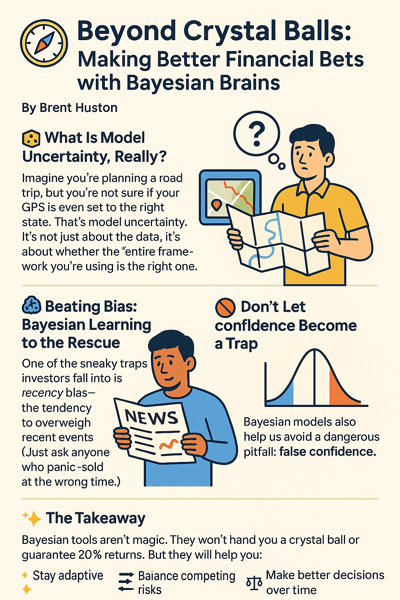
* AI tools were used as a research assistant for this content, but human moderation and writing are also included. The included images are AI-generated.




 Not Quite Random