Building Logic with Language: Using Pseudo Code Prompts to Shape AI Behavior

Introduction

It started as an experiment. Just an idea — could we use pseudo code, written in plain human language, to define tasks for AI platforms in a structured, logical way? Not programming, exactly. Not scripting. But something between instruction and automation. And to my surprise — it worked. At least in early testing, platforms like Claude Sonnet 4 and Perplexity have been responding in consistently usable ways. This post outlines the method I’ve been testing, broken into three sections: Inputs, Task Logic, and Outputs. It’s early, but I think this structure has the potential to evolve into a kind of “prompt language” — a set of building blocks that could power a wide range of rule-based tools and reusable logic trees.

A close up shot reveals code flowing across the hackers computer screen as they work to gain access to the system The code is complex and could take days or weeks for a novice user to understand 9195529

Section 1: Inputs

The first section of any pseudo code prompt needs to make the data sources explicit. In my experiments, that means spelling out exactly where the AI should look — URLs, APIs, or internal data sets. Being explicit in this section has two advantages: it limits hallucination by narrowing the AI’s attention, and it standardizes the process, so results are more repeatable across runs or across different models.

# --- INPUTS ---
Sources:
- DrudgeReport (https://drudgereport.com/)
- MSN News (https://www.msn.com/en-us/news)
- Yahoo News (https://news.yahoo.com/)

Each source is clearly named and linked, making the prompt both readable and machine-parseable by future tools. It’s not just about inputs — it’s about documenting the scope of trust and context for the model.

Section 2: Task Logic

This is the core of the approach: breaking down what we want the AI to do in clear, sequential steps. No heavy syntax. Just numbered logic, indentation for subtasks, and simple conditional statements. Think of it as logic LEGO — modular, stackable, and understandable at a glance.

# --- TASK LOGIC ---
1. Scrape and parse front-page headlines and article URLs from all three sources.
2. For each headline:
   a. Fetch full article text.
   b. Extract named entities, events, dates, and facts using NER and event detection.
3. Deduplicate:
   a. Group similar articles across sources using fuzzy matching or semantic similarity.
   b. Merge shared facts; resolve minor contradictions based on majority or confidence weighting.
4. Prioritize and compress:
   a. Reduce down to significant, non-redundant points that are informational and relevant.
   b. Eliminate clickbait, vague, or purely opinion-based content unless it reflects significant sentiment shift.
5. Rate each item:
   a. Assign sentiment as [Positive | Neutral | Negative].
   b. Assign a probability of truthfulness based on:
      - Agreement between sources
      - Factual consistency
      - Source credibility
      - Known verification via primary sources or expert commentary

What’s emerging here is a flexible grammar of logic. Early tests show that platforms can follow this format surprisingly well — especially when the tasks are clearly modularized. Even more exciting: this structure hints at future libraries of reusable prompt modules — small logic trees that could plug into a larger system.

Section 3: Outputs

The third section defines the structure of the expected output — not just format, but tone, scope, and filters for relevance. This ensures that different models produce consistent, actionable results, even when their internal mechanics differ.

# --- OUTPUT ---
Structured listicle format:
- [Headline or topic summary]
- Detail: [1–2 sentence summary of key point or development]
- Sentiment: [Positive | Neutral | Negative]
- Truth Probability: [XX%]

It’s not about precision so much as direction. The goal is to give the AI a shape to pour its answers into. This also makes post-processing or visualization easier, which I’ve started exploring using Perplexity Labs.

Conclusion

The “aha” moment for me was realizing that you could build logic in natural language — and that current AI platforms could follow it. Not flawlessly, not yet. But well enough to sketch the blueprint of a new kind of rule-based system. If we keep pushing in this direction, we may end up with prompt grammars or libraries — logic that’s easy to write, easy to read, and portable across AI tools.

This is early-phase work, but the possibilities are massive. Whether you’re aiming for decision support, automation, research synthesis, or standardizing AI outputs, pseudo code prompts are a fascinating new tool in the kit. More experiments to come.


* AI tools were used as a research assistant for this content, but human moderation and writing are also included. The included images are AI-generated.

Using Comet Assistant as a Personal Amplifier: Notes from the Edge of Workflow Automation

Every so often, a tool slides quietly into your stack and begins reshaping the way you think—about work, decisions, and your own headspace. Comet Assistant did exactly that for me. Not with fireworks, but with frictionlessness. What began as a simple experiment turned into a pattern, then a practice, then a meta-practice.

ChatGPT Image Aug 7 2025 at 10 16 18 AM

I didn’t set out to study my usage patterns with Comet. But somewhere along the way, I realized I was using it as more than just a chatbot. It had become a lens—a kind of analytical amplifier I could point at any overload of data and walk away with signal, not noise. The deeper I leaned in, the more strategic it became.

From Research Drain to Strategic Clarity

Let’s start with the obvious: there’s too much information out there. News feeds, trend reports, blog posts—endless and noisy. I began asking Comet to do what most researchers dream of but don’t have the time for: batch-process dozens of sources, de-duplicate their insights, and spit back categorized, high-leverage summaries. I’d feed it a prompt like:

“Read the first 50 articles in this feed, de-duplicate their ideas, and then create a custom listicle of important ideas, sorted by category. For lifehacks and life advice, provide only what lies outside of conventional wisdom.”

The result? Not just summaries, but working blueprints. Idea clusters, trend intersections, and most importantly—filters. Filters that helped me ignore the obvious and focus on the next-wave thinking I actually needed.

The Prompt as Design Artifact

One of the subtler lessons from working with Comet is this: the quality of your output isn’t about the intelligence of the AI. It’s about the specificity of your question. I started writing prompts like they were little design challenges:

  • Prioritize newness over repetition.

  • Organize outputs by actionability, not just topic.

  • Strip out anything that could be found in a high school self-help book.

Over time, the prompts became reusable components. Modular mental tools. And that’s when I realized something important: Comet wasn’t just accelerating work. It was teaching me to think in structures.

Synthesis at the Edge

Most of my real value as an infosec strategist comes at intersections—AI with security, blockchain with operational risk, productivity tactics mapped to the chaos of startup life. Comet became a kind of cognitive fusion reactor. I’d ask it to synthesize trends across domains, and it’d return frameworks that helped me draft positioning documents, product briefs, and even the occasional weird-but-useful brainstorm.

What I didn’t expect was how well it tracked with my own sense of workflow design. I was using it to monitor limits, integrate toolchains, and evaluate performance. I asked it for meta-analysis on how I was using it. That became this very blog post.

The Real ROI: Pattern-Aware Workflows

It’s tempting to think of tools like Comet as assistants. But that sells them short. Comet is more like a co-processor. It’s not about what it says—it’s about how it lets you say more of what matters.

Here’s what I’ve learned matters most:

  • Custom Formatting Matters: Generic summaries don’t move the needle. Structured outputs—by insight type, theme, or actionability—do.

  • Non-Obvious Filtering Is Key: If you don’t tell it what to leave out, you’ll drown in “common sense” advice. Get specific, or get buried.

  • Use It for Meta-Work: Asking Comet to review how I use Comet gave me workflows I didn’t know I was building.

One Last Anecdote

At one point, I gave it this prompt:

“Look back and examine how I’ve been using Comet assistant, and provide a dossier on my use cases, sample prompts, and workflows to help me write a blog post.”

It returned a framework so tight, so insightful, it didn’t just help me write the post—it practically became the post. That kind of recursive utility is rare. That kind of reflection? Even rarer.

Closing Thought

I don’t think of Comet as AI anymore. I think of it as part of my cognitive toolkit. A prosthetic for synthesis. A personal amplifier that turns workflow into insight.

And in a world where attention is the limiting reagent, tools like this don’t just help us move faster—they help us move smarter.


* AI tools were used as a research assistant for this content, but human moderation and writing are also included. The included images are AI-generated.

Getting DeepSeek R1 Running on Your Pi 5 (16 GB) with Open WebUI, RAG, and Pipelines

🚀 Introduction

Running DeepSeek R1 on a Pi 5 with 16 GB RAM feels like taking that same Pi 400 project from my February guide and super‑charging it. With more memory, faster CPU cores, and better headroom, we can use Open WebUI over Ollama, hook in RAG, and even add pipeline automations—all still local, all still low‑cost, all privacy‑first.

PiAI


💡 Why Pi 5 (16 GB)?

Jeremy Morgan and others have largely confirmed what we know: Raspberry Pi 5 with 8 GB or 16 GB is capable of managing the deepseek‑r1:1.5b model smoothly, hitting around 6 tokens/sec and consuming ~3 GB RAM (kevsrobots.comdev.to).

The extra memory gives breathing room for RAGpipelines, and more.


🛠️ Prerequisites & Setup

  • OS: Raspberry Pi OS (64‑bit, Bookworm)

  • Hardware: Pi 5, 16 GB RAM, 32 GB+ microSD or SSD, wired or stable Wi‑Fi

  • Tools: Docker, Docker Compose, access to terminal

🧰 System prep

bash
CopyEdit
sudo apt update && sudo apt upgrade -y
sudo apt install curl git

Install Docker & Compose:

bash
CopyEdit
curl -fsSL https://get.docker.com | sh
sudo usermod -aG docker $USER
newgrp docker

Install Ollama (ARM64):

bash
CopyEdit
curl -fsSL https://ollama.com/install.sh | sh
ollama --version

⚙️ Docker Compose: Ollama + Open WebUI

Create the stack folder:

bash
CopyEdit
sudo mkdir -p /opt/stacks/openwebui
cd /opt/stacks/openwebui

Then create docker-compose.yaml:

yaml
CopyEdit
services:
ollama:
image: ghcr.io/ollama/ollama:latest
volumes:
- ollama:/root/.ollama
ports:
- "11434:11434"
open-webui:
image: ghcr.io/open-webui/open-webui:ollama
container_name: open-webui
ports:
- "3000:8080"
volumes:
- openwebui_data:/app/backend/data
restart: unless-stopped

volumes:
ollama:
openwebui_data:

Bring it online:

bash
CopyEdit
docker compose up -d

✅ Ollama runs on port 11434Open WebUI on 3000.


📥 Installing DeepSeek R1 Model

In terminal:

bash
CopyEdit
ollama pull deepseek-r1:1.5b

In Open WebUI (visit http://<pi-ip>:3000):

  1. 🧑‍💻 Create your admin user

  2. ⚙️ Go to Settings → Models

  3. ➕ Pull deepseek-r1:1.5b via UI

Once added, it’s selectable from the top model dropdown.


💬 Basic Usage & Performance

Select deepseek-r1:1.5b, type your prompt:

→ Expect ~6 tokens/sec
→ ~3 GB RAM usage
→ CPU fully engaged

Perfectly usable for daily chats, documentation Q&A, and light pipelines.


📚 Adding RAG with Open WebUI

Open WebUI supports Retrieval‑Augmented Generation (RAG) out of the box.

Steps:

  1. 📄 Collect .md or .txt files (policies, notes, docs).

  2. ➕ In UI: Workspace → Knowledge → + Create Knowledge Base, upload your docs.

  3. 🧠 Then: Workspace → Models → + Add New Model

    • Model name: DeepSeek‑KB

    • Base model: deepseek-r1:1.5b

    • Knowledge: select the knowledge base

The result? 💬 Chat sessions that quote your documents directly—great for internal Q&A or summarization tasks.


🧪 Pipeline Automations

This is where things get real fun. With Pipelines, Open WebUI becomes programmable.

🧱 Start the pipelines container:

bash
CopyEdit
docker run -d -p 9099:9099 \
--add-host=host.docker.internal:host-gateway \
-v pipelines:/app/pipelines \
--name pipelines ghcr.io/open-webui/pipelines:main

Link it via WebUI Settings (URL: http://host.docker.internal:9099)

Now build workflows:

  • 🔗 Chain prompts (e.g. translate → summarize → translate back)

  • 🧹 Clean/filter input/output

  • ⚙️ Trigger external actions (webhooks, APIs, home automation)

Write custom Python logic and integrate it as a processing step.


🧭 Example Use Cases

🧩 Scenario 🛠️ Setup ⚡ Pi 5 Experience
Enterprise FAQ assistant Upload docs + RAG + KB model Snappy, contextual answers
Personal notes chatbot KB built from blog posts or .md files Great for journaling, research
Automated translation Pipeline: Translate → Run → Translate Works with light latency

📝 Tips & Gotchas

  • 🧠 Stick with 1.5B models for usability.

  • 📉 Monitor RAM and CPU; disable swap where possible.

  • 🔒 Be cautious with pipeline code—no sandboxing.

  • 🗂️ Use volume backups to persist state between upgrades.


🎯 Conclusion

Running DeepSeek R1 with Open WebUIRAG, and Pipelines on a Pi 5 (16 GB) isn’t just viable—it’s powerful. You can create focused, contextual AI tools completely offline. You control the data. You own the results.

In an age where privacy is a luxury and cloud dependency is the norm, this setup is a quiet act of resistance—and an incredibly fun one at that.

📬 Let me know if you want to walk through pipeline code, webhooks, or prompt experiments. The Pi is small—but what it teaches us is huge.


* AI tools were used as a research assistant for this content, but human moderation and writing are also included. The included images are AI-generated.

Zero-Trust Privacy Methodology for Individuals & Families

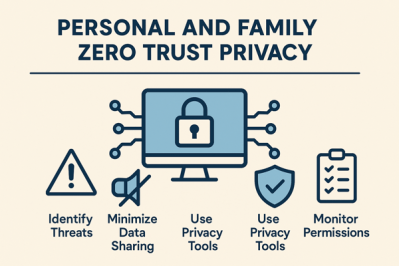
I set out to create a Zero Trust methodology for personal and family use. I have been interested in Zero Trust in information security foe years, and wondered what it might look like if I applied it to privacy on a personal level. Here is what I came up with:

PersonalZeroTrustPrivacy

Key takeaway: Secure your digital life by treating every account, device, network segment and data collection request as untrusted until proven otherwise. The roadmap below translates enterprise zero-trust ideas into a practical, repeatable program you can run at home.

1. Baseline Assessment (Week 1)

Task Why it matters How to do it
Inventory accounts, devices & data You can’t protect what you don’t know List every online account, smart-home device, computer, phone and the sensitive data each holds (e.g., health, finance, photos)12
Map trust relationships Reveals hidden attack paths Note which devices talk to one another and which accounts share log-ins or recovery e-mails34
Define risk tolerance Sets priorities Rank what would hurt most if stolen or leaked (identity, kids’ photos, medical files, etc.)5
 

2. Harden Identity & Access (Weeks 2-3)

Zero-Trust Principle Home Implementation Recommended Tools
Verify explicitly – Use a password manager to generate unique 16-character passwords – Turn on 2FA everywhere—prefer security keys for critical accounts67 1Password, Bitwarden + two FIDO2 keys
Least-privilege Share one family admin e-mail for critical services; give kids “child” or “guest” roles on devices rather than full admin rights8 Family Microsoft/Apple parental controls
Assume breach Create two recovery channels (second e-mail, phone) kept offline; store them in a fire-resistant safe6 Encrypted USB, paper copy
 

3. Secure Devices & Home Network (Weeks 3-4)

Layer Zero-Trust Control Concrete Steps
Endpoints Continuous posture checks Enable full-disk encryption, automatic patching and screen-lock timeouts on every phone, laptop and tablet56
IoT & guests Micro-segmentation Put smart-home gear on a separate SSID/VLAN; create a third “visitor” network with Internet-only access34
Router Strong identity & monitoring Change default admin password, enable WPA3, schedule automatic firmware updates and log remote-access attempts3
 

4. Protect Data Itself (Week 5)

  1. Encrypt sensitive documents locally (VeraCrypt, macOS FileVault).

  2. Use end-to-end–encrypted cloud storage (Proton Drive, Tresorit) not generic sync tools.

  3. Enable on-device backups and keep an offline copy (USB or NAS) rotated monthly16.

  4. Tokenize payment data with virtual cards and lock credit files to stop identity fraud6.

5. Data Hygiene & Minimization (Ongoing)

Habit Zero-Trust Rationale Frequency
Delete unused accounts & apps Reduce attack surface9 Quarterly
Scrub excess data (old emails, trackers, location history) Limit collateral damage if breached52 Monthly
Review social-media privacy settings Remove implicit trust in platforms9 After each major app update
Sanitize devices before resale Remove residual trust relationships When decommissioning hardware
 

6. Continuous Verification & Response (Ongoing)

  1. Automated Alerts – Turn on login-alert e-mails/SMS for major accounts and bank transactions7.

  2. Log Review Ritual – The first Sunday each month, scan password-manager breach reports, router logs and mobile “security & privacy” dashboards62.

  3. Incident Playbook – Pre-write steps for lost phone, compromised account or identity-theft notice: remote-wipe, password reset, credit freeze, police/FCC report5.

  4. Family Drills – Teach children to spot phishing, approve app permissions and ask before connecting a new device to Wi-Fi810.

7. Maturity Ladder

Level Description Typical Signals
Initial Strong passwords + MFA Few data-breach notices, but ad-tracking still visible
Advanced Network segmentation, encrypted cloud, IoT isolation No personalized ads, router logs clean
Optimal Hardware security keys, regular audits, locked credit, scripted backups Rare breach alerts, quick recovery rehearsed
 

Progress one level at a time; zero trust is a journey, not a switch.

Quick-Start 30-Day Checklist

Day Action
1-2 Complete inventory spreadsheet
3-5 Install password manager, reset top-20 account passwords
6-7 Buy two FIDO2 keys, enroll in critical accounts
8-10 Enable full-disk encryption on every device
11-15 Segment Wi-Fi (main, IoT, guest); update router firmware
16-18 Encrypt and back up sensitive documents
19-22 Delete five unused online accounts; purge old app data
23-26 Freeze credit files; set up credit alerts
27-28 Draft incident playbook; print and store offline
29-30 Family training session + schedule monthly log-review reminder
 

Why This Works

  • No implicit trust anywhere—every login, device and data request is re-authenticated or cryptographically protected34.

  • Attack surface shrinks—unique credentials, network segmentation and data minimization deny adversaries lateral movement511.

  • Rapid recovery—auditable logs, offline backups and a pre-built playbook shorten incident response time76.

Adopting these habits turns zero trust from a corporate buzzword into a sustainable family lifestyle that guards privacy, finances and peace of mind.


Support My Work

Support the creation of high-impact content and research. Sponsorship opportunities are available for specific topics, whitepapers, tools, or advisory insights. Learn more or contribute here: Buy Me A Coffee


 

References:

  1. https://bysafeonline.com/how-to-get-good-data-hygiene/
  2. https://github.com/Lissy93/personal-security-checklist
  3. https://www.mindpointgroup.com/blog/applying-the-principles-of-zero-trust-architecture-to-your-home-network
  4. https://www.forbes.com/sites/alexvakulov/2025/03/06/secure-your-home-network-with-zero-trust-security-best-practices/
  5. https://www.enisa.europa.eu/topics/cyber-hygiene
  6. https://guptadeepak.com/essential-security-privacy-checklist-2025-personal/
  7. https://www.fultonbank.com/Education-Center/Privacy-and-Security/Online-Privacy-Checklist
  8. https://www.reddit.com/r/privacy/comments/1jnhvmg/what_are_all_the_privacy_mustdos_that_one_should/
  9. https://privacybee.com/blog/digital-hygiene-warning-signs/
  10. https://www.infosecurityeurope.com/en-gb/blog/guides-checklists/10-everyday-practices-to-enhance-digital-security.html
  11. https://aws.amazon.com/security/zero-trust/
  12. https://www.okta.com/identity-101/zero-trust-framework-a-comprehensive-modern-security-model/
  13. https://www.reddit.com/r/PrivacyGuides/comments/1441euo/what_are_say_the_top_510_most_important/
  14. https://www.microsoft.com/en-us/security/business/zero-trust
  15. https://www.ssh.com/academy/iam/zero-trust-framework
  16. https://www.gpo.gov/docs/default-source/accessibility-privacy-coop-files/basic-privacy-101-for-public-website-04112025.pdf
  17. https://nordlayer.com/learn/zero-trust/what-is-zero-trust/
  18. https://www.priv.gc.ca/en/privacy-topics/information-and-advice-for-individuals/your-privacy-rights/02_05_d_64_tips/
  19. https://www.mindpointgroup.com/blog/securing-your-home-office-from-iot-devices-with-zta
  20. https://www.crowdstrike.com/en-us/cybersecurity-101/zero-trust-security/
  21. https://www.digitalguardian.com/blog/data-privacy-best-practices-ensure-compliance-security
  22. https://www.fortinet.com/resources/cyberglossary/how-to-implement-zero-trust
  23. https://www.cisa.gov/zero-trust-maturity-model
  24. https://www.cisco.com/site/us/en/learn/topics/networking/what-is-zero-trust-networking.html
  25. https://www.fortra.com/solutions/zero-trust
  26. https://lumenalta.com/insights/11-best-practices-for-data-privacy-and-compliance
  27. https://www.cloudflare.com/learning/security/glossary/what-is-zero-trust/
  28. https://www.fortinet.com/resources/cyberglossary/what-is-the-zero-trust-network-security-model
  29. https://www.keepersecurity.com/solutions/zero-trust-security.html
  30. https://it.cornell.edu/security-and-policy/data-hygiene-best-practices
  31. https://termly.io/resources/checklists/privacy-policy-requirements/
  32. https://www.hipaajournal.com/hipaa-compliance-checklist/
  33. https://guardiandigital.com/resources/blog/cyber-hygiene-data-protection
  34. https://dodcio.defense.gov/Portals/0/Documents/Library/ZeroTrustOverlays.pdf
  35. https://www.mightybytes.com/blog/data-privacy-checklist-free-download/
  36. https://www.reddit.com/r/AskNetsec/comments/10h1b3q/what_is_zerotrust_outside_of_the_marketing_bs/
  37. https://www.techtarget.com/searchsecurity/definition/cyber-hygiene

Market Intelligence for the Rest of Us: Building a $2K AI for Startup Signals

It’s a story we hear far too often in tech circles: powerful tools locked behind enterprise price tags. If you’re a solo founder, indie investor, or the kind of person who builds MVPs from a kitchen table, the idea of paying $2,000 a month for market intelligence software sounds like a punchline — not a product. But the tide is shifting. Edge AI is putting institutional-grade analytics within reach of anyone with a soldering iron and some Python chops.

Pi400WithAI

Edge AI: A Quiet Revolution

There’s a fascinating convergence happening right now: the Raspberry Pi 400, an all-in-one keyboard-computer for under $100, is powerful enough to run quantized language models like TinyLLaMA. These aren’t toys. They’re functional tools that can parse financial filings, assess sentiment, and deliver real-time insights from structured and unstructured data.

The performance isn’t mythical either. When you quantize a lightweight LLM to 4-bit precision, you retain 95% of the accuracy while dropping memory usage by up to 70%. That’s a trade-off worth celebrating, especially when you’re paying 5–15 watts to keep the whole thing running. No cloud fees. No vendor lock-in. Just raw, local computation.

The Indie Investor’s Dream Stack

The stack described in this setup is tight, scrappy, and surprisingly effective:

  • Raspberry Pi 400: Your edge AI hardware base.

  • TinyLLaMA: A lean, mean 1.1B-parameter model ready for signal extraction.

  • VADER: Old faithful for quick sentiment reads.

  • SEC API + Web Scraping: Data collection that doesn’t rely on SaaS vendors.

  • SQLite or CSV: Because sometimes, the simplest storage works best.

If you’ve ever built anything in a bootstrapped environment, this architecture feels like home. Minimal dependencies. Transparent workflows. And full control of your data.

Real-World Application, Real-Time Signals

From scraping startup news headlines to parsing 10-Ks and 8-Ks from EDGAR, the system functions as a low-latency, always-on market radar. You’re not waiting for quarterly analyst reports or delayed press releases. You’re reading between the lines in real time.

Sentiment scores get calculated. Signals get aggregated. If the filings suggest a risk event while the news sentiment dips negative? You get a notification. Email, Telegram bot, whatever suits your alert style.

The dashboard component rounds it out — historical trends, portfolio-specific signals, and current market sentiment all wrapped in a local web UI. And yes, it works offline too. That’s the beauty of edge.

Why This Matters

It’s not just about saving money — though saving over $46,000 across three years compared to traditional tools is no small feat. It’s about reclaiming autonomy in an industry that’s increasingly centralized and opaque.

The truth is, indie analysts and small investment shops bring valuable diversity to capital markets. They see signals the big firms overlook. But they’ve lacked the tooling. This shifts that balance.

Best Practices From the Trenches

The research set outlines some key lessons worth reiterating:

  • Quantization is your friend: 4-bit LLMs are the sweet spot.

  • Redundancy matters: Pull from multiple sources to validate signals.

  • Modular design scales: You may start with one Pi, but load balancing across a cluster is just a YAML file away.

  • Encrypt and secure: Edge doesn’t mean exempt from risk. Secure your API keys and harden your stack.

What Comes Next

There’s a roadmap here that could rival a mid-tier SaaS platform. Social media integration. Patent data. Even mobile dashboards. But the most compelling idea is community. Open-source signal strategies. GitHub repos. Tutorials. That’s the long game.

If we can democratize access to investment intelligence, we shift who gets to play — and who gets to win.


Final Thoughts

I love this project not just for the clever engineering, but for the philosophy behind it. We’ve spent decades building complex, expensive systems that exclude the very people who might use them in the most novel ways. This flips the script.

If you’re a founder watching the winds shift, or an indie VC tired of playing catch-up, this is your chance. Build the tools. Decode the signals. And most importantly, keep your stack weird.

How To:


Build Instructions: DIY Market Intelligence

This system runs best when you treat it like a home lab experiment with a financial twist. Here’s how to get it up and running.

🧰 Hardware Requirements

  • Raspberry Pi 400 ($90)

  • 128GB MicroSD card ($25)

  • Heatsink/fan combo (optional, $10)

  • Reliable internet connection

🔧 Phase 1: System Setup

  1. Install Raspberry Pi OS Desktop

  2. Update and install dependencies

    sudo apt update -y && sudo apt upgrade -y
    sudo apt install python3-pip -y
    pip3 install pandas nltk transformers torch
    python3 -c "import nltk; nltk.download('all')"
    

🌐 Phase 2: Data Collection

  1. News Scraping

    • Use requests + BeautifulSoup to parse RSS feeds from financial news outlets.

    • Filter by keywords, deduplicate articles, and store structured summaries in SQLite.

  2. SEC Filings

    • Install sec-api:

      pip3 install sec-api
      
    • Query recent 10-K/8-Ks and store the content locally.

    • Extract XBRL data using Python’s lxml or bs4.


🧠 Phase 3: Sentiment and Signal Detection

  1. Basic Sentiment: VADER

    from nltk.sentiment.vader import SentimentIntensityAnalyzer
    analyzer = SentimentIntensityAnalyzer()
    scores = analyzer.polarity_scores(text)
    
  2. Advanced LLMs: TinyLLaMA via Ollama

    • Install Ollama: ollama.com

    • Pull and run TinyLLaMA locally:

      ollama pull tinyllama
      ollama run tinyllama
      
    • Feed parsed content and use the model for classification, signal extraction, and trend detection.


📊 Phase 4: Output & Monitoring

  1. Dashboard

    • Use Flask or Streamlit for a lightweight local dashboard.

    • Show:

      • Company-specific alerts

      • Aggregate sentiment trends

      • Regulatory risk events

  2. Alerts

    • Integrate with Telegram or email using standard Python libraries (smtplibpython-telegram-bot).

    • Send alerts when sentiment dips sharply or key filings appear.


Use Cases That Matter

🕵️ Indie VC Deal Sourcing

  • Monitor startup mentions in niche publications.

  • Score sentiment around funding announcements.

  • Identify unusual filing patterns ahead of new rounds.

🚀 Bootstrapped Startup Intelligence

  • Track competitors’ regulatory filings.

  • Stay ahead of shifting sentiment in your vertical.

  • React faster to macroeconomic events impacting your market.

⚖️ Risk Management

  • Flag negative filing language or missing disclosures.

  • Detect regulatory compliance risks.

  • Get early warning on industry disruptions.


Lessons From the Edge

If you’re already spending $20/month on ChatGPT and juggling half a dozen spreadsheets, consider this your signal. For under $2K over three years, you can build a tool that not only pays for itself, but puts you on competitive footing with firms burning $50K on dashboards and dashboards about dashboards.

There’s poetry in this setup: lean, fast, and local. Like the best tools, it’s not just about what it does — it’s about what it enables. Autonomy. Agility. Insight.

And perhaps most importantly, it’s yours.


Support My Work and Content Like This

Support the creation of high-impact content and research. Sponsorship opportunities are available for specific topics, whitepapers, tools, or advisory insights. Learn more or contribute here: Buy Me A Coffee


* AI tools were used as a research assistant for this content, but human moderation and writing are also included. The included images are AI-generated.


Tool Deep Dive: Mental Models Tracker + AI Insights

The productivity and rational-thinking crowd has long loved mental models. We memorize them. We quote them. We sprinkle them into conversations like intellectual seasoning. But here’s the inconvenient truth: very few of us actually track how we use them. Even fewer build systems to reinforce their practical application in daily life. That gap is where this tool deep dive lands.

MentalModels

The Problem: Theory Without a Feedback Loop

You know First Principles Thinking, Inversion, Opportunity Cost, Hanlon’s Razor, the 80/20 Rule, and the rest. But do you know if you’re actually applying them consistently? Or are they just bouncing around in your head, waiting to be summoned by a Twitter thread?

In an increasingly AI-enabled work landscape, knowing mental models isn’t enough. Systems thinking alone won’t save you. Implementation will.

Why Now: The Implementation Era

AI isn’t just a new toolset. It’s a context shifter. We’re all being asked to think faster, act more strategically, and manage complexity in real-time. It’s not just about understanding systems, but executing decisions with clarity and intention. That means our cognitive infrastructure needs reinforcing.

The Tracker: One Week to Conscious Application

I ran a simple demo: one week, one daily journal template, tracking how mental models showed up (or could have) in real-world decisions.

  • A decision or scenario I encountered
  • Which models I applied (or neglected)
  • The outcome (or projected cost of neglect)
  • Reflections on integration with MATTO

You can download the journal template here.

AI Prompt: Your On-Demand Decision Partner

Here’s the ChatGPT prompt I used daily:

“I’m going to describe a situation I encountered today. I want you to help me analyze it using the following mental models: First Principles, Inversion, Opportunity Cost, Diminishing Returns, Hanlon’s Razor, Parkinson’s Law, Loss Aversion, Switching Costs, Circle of Competence, Regret Minimization, Pareto Principle, and Game Theory. First, tell me which models are most relevant. Then, walk me through how to apply them. Then, ask me reflective questions for journaling.”

Integration with MATTO: Tracking the True Cost

In my journaling system, I use MATTO (Money, Attention, Time, Trust, Opportunity) to score decisions. After a model analysis, I tag entries with their relevant MATTO implications:

  • Did I spend unnecessary attention by failing to invert?
  • Did loss aversion skew my sense of opportunity?
  • Was trust eroded due to ignoring second-order consequences?

Final Thought: Self-Awareness at Scale

We don’t need more models. We need mechanisms.

This is a small experiment in building them. Give it a week. Let your decisions become a training dataset. The clarity you’ll gain might just be the edge you’re looking for.

Support My Work

Support the creation of high-impact content and research. Sponsorship opportunities are available for specific topics, whitepapers, tools, or advisory insights. Learn more or contribute here: Buy Me A Coffee


* AI tools were used as a research assistant for this content, but human moderation and writing are also included. The included images are AI-generated.

The Heisenberg Principle, Everyday Life, and Cybersecurity: Embracing Uncertainty

You’ve probably heard of the Heisenberg Uncertainty Principle — that weird quantum physics thing that says you can’t know where something is and how fast it’s going at the same time. But what does that actually mean, and more importantly, how can we use it outside of a physics lab?

Here’s the quick version:
At the quantum level, the more precisely you try to measure the position of a particle (like an electron), the less precisely you can know its momentum (its speed and direction). And vice versa. It’s not about having bad tools — it’s a built-in feature of the universe. The act of observing disturbs the system.

Heis

Now, for anything bigger than a molecule, this doesn’t really apply. You can measure the location and speed of your car without it vanishing into a probability cloud. The effects at our scale are so tiny they’re basically zero. But that doesn’t mean Heisenberg’s idea isn’t useful. In fact, I think it’s a perfect metaphor for both life and cybersecurity.

Here’s how I’ve been applying it:

1. Observation Changes Behavior

In security and in business, watching something often changes how it behaves. Put monitoring software on endpoints, and employees become more cautious. Watch a threat actor closely, and they’ll shift tactics. Just like in quantum physics, observation isn’t passive — it has consequences.

2. Focus Creates Blind Spots

In incident response, zeroing in on a single alert might help you track one bad actor — but you might miss the bigger pattern. Focus too much on endpoint logs and you might miss lateral movement in cloud assets. The more precisely you try to measure one thing, the fuzzier everything else becomes. Sound familiar?

3. Know the Limits of Certainty

The principle reminds us that perfect knowledge is a myth. There will always be unknowns — gaps in visibility, unknown unknowns in your threat model, or behaviors that can’t be fully predicted. Instead of chasing total control, we should optimize for resilience and responsiveness.

4. Think Probabilistically

Security decisions (and life choices) benefit from probability thinking. Nothing is 100% secure or 100% safe. But you can estimate, adapt, and prepare. The world’s fuzzy — accept it, work with it, and use it to your advantage.

Final Thought

The Heisenberg Principle isn’t just for physicists. It’s a sharp reminder that trying to know everything can actually distort the system you’re trying to understand. Whether you’re debugging code, designing a threat detection strategy, or just navigating everyday choices, uncertainty isn’t a failure — it’s part of the system. Plan accordingly.


* AI tools were used as a research assistant for this content, but human moderation and writing are also included. The included images are AI-generated.

MATTO: A Lens for Measuring the True Cost of Anything

Every decision you make comes with a price — but the real cost isn’t always just dollars and cents. That’s where MATTO comes in.

Matto

MATTO stands for Money, Attention, Time, Turbulence, and Opportunity. It’s a framework I’ve been using for years to evaluate whether a new project, commitment, or hobby is worth taking on. Think of it as a currency-based lens for life. Every undertaking has a cost, and it usually extracts something from each of these currencies — whether you’re consciously tracking it or not.

Here’s how I use MATTO to make better decisions, avoid burnout, and keep my energy focused on what truly matters.

M is for Money

This one’s the easiest to calculate, but often the most misleading if taken in isolation. The money cost is the actual financial impact of the thing you’re considering. Will you need to buy equipment, software, or services? Are there recurring costs? What’s the long-term spend?

Say I want to pick up kayaking. The money cost isn’t just the kayak — it’s the paddle, the roof rack, the life vest, the boat registration, and probably a few “surprise” purchases along the way. I always ask: is the spend worth the return to me?

A is for Attention

This one’s sneakier. Attention is a currency that only time or sleep can replenish. So, I guard it carefully.

Attention cost is about the mental load. How much new information will I have to absorb? How much learning is required? Will I need to spend weeks ramping up before I can even begin to enjoy it?

With a work project, I ask: How much new thinking will this require? Can I apply any adjacent skills to make it easier? Am I likely to fail forward, or is this going to drain my headspace and leave me exhausted?

I usually rate attention cost as high, medium, or low — and I take that rating seriously.

T is for Time

This isn’t about how mentally demanding something is — it’s about your calendar. How many hours or days will this take? How much of my lifespan and healthspan am I willing to spend here?

Time is the only currency you can’t earn back.

Personally, I block out time for everything. So when I’m considering something new, I ask: how many of my time blocks will it require? Are those blocks available? And if I spend them here, what won’t get done?

For kayaking: Will I actually get out on the water, or will the kayak gather dust in the garage because I overestimated my free weekends?

T is for Turbulence

Turbulence is the emotional and interpersonal chaos a project might introduce.

Will this bring drama into my life? Will I be working with people I enjoy, or people who drain me? Will it interrupt my routines or interfere with other commitments? Will it stress me out, or cause strain with family and friends?

A high-turbulence project might technically be a “good opportunity,” but if it leaves me exhausted, irritated, or distant from my loved ones — it’s probably not worth it.

O is for Opportunity

Every “yes” is a “no” to something else. That’s the law of opportunity cost.

So I ask: If I say yes to this, what am I saying no to? What other opportunities am I cutting off? Is there something with a higher ROI — whether in satisfaction, growth, or future flexibility — that I’m neglecting?

Sometimes, the opportunity gained outweighs all the other costs. Sometimes, the opportunity lost is a dealbreaker. It’s a tradeoff every time — and I try to make that tradeoff with eyes wide open.

MATTO in the Real World

Using the MATTO framework doesn’t mean I always make the perfect decision. But it does help me make intentional ones.

Whether I’m picking up a new hobby, saying yes to a consulting gig, or deciding whether to join a new team, I run it through the MATTO lens. I look at what each currency will cost me and whether that investment aligns with my values and current priorities.

Sometimes, the price is worth it. Sometimes, it’s not.

Either way, I walk in with clarity — and more often than not, that makes all the difference.


The Huston Approach to Knowledge Management: A System for the Curious Mind

I’ve always believed that managing knowledge is about more than just collecting information—it’s about refining, synthesizing, and applying it. In my decades of work in cybersecurity, business, and technology, I’ve had to develop an approach that balances deep research with practical application, while ensuring that I stay ahead of emerging trends without drowning in information overload.

KnowledgeMgmt

This post walks through my knowledge management approach, the tools I use, and how I leverage AI, structured learning, and rapid skill acquisition to keep my mind sharp and my work effective.

Deep Dive Research: Building a Foundation of Expertise

When I need to do a deep dive into a new topic—whether it’s a cutting-edge security vulnerability, an emerging AI model, or a shift in the digital threat landscape—I use a carefully curated set of tools:

  • AI-Powered Research: ChatGPT, Perplexity, Claude, Gemini, LMNotebook, LMStudio, Apple Summarization
  • Content Digestion Tools: Kindle books, Podcasts, Readwise, YouTube Transcription Analysis, Evernote

The goal isn’t just to consume information but to synthesize it—connecting the dots across different sources, identifying patterns, and refining key takeaways for practical use.

Trickle Learning & Maintenance: Staying Current Without Overload

A key challenge in knowledge management is not just learning new things but keeping up with ongoing developments. That’s where trickle learning comes in—a lightweight, recurring approach to absorbing new insights over time.

  • News Aggregation & Summarization: Readwise, Newsletters, RSS Feeds, YouTube, Podcasts
  • AI-Powered Curation: ChatGPT Recurring Tasks, Bayesian Analysis GPT
  • Social Learning: Twitter streams, Slack channels, AI-assisted text analysis

Micro-Learning: The Art of Absorbing Information in Bite-Sized Chunks

Sometimes, deep research isn’t necessary. Instead, I rely on micro-learning techniques to absorb concepts quickly and stay versatile.

  • 12Min, Uptime, Heroic, Medium, Reddit
  • Evernote as a digital memory vault
  • AI-assisted text extraction and summarization

Rapid Skills Acquisition: Learning What Matters, Fast

There are times when I need to master a new skill rapidly—whether it’s understanding a new technology, a programming language, or an industry shift. For this, I combine:

  • Batch Processing of Content: AI analysis of YouTube transcripts and articles
  • AI-Driven Learning Tools: ChatGPT, Perplexity, Claude, Gemini, LMNotebook
  • Evernote for long-term storage and retrieval

Final Thoughts: Why Knowledge Management Matters

The world is overflowing with information, and most people struggle to make sense of it. My knowledge management system is designed to cut through the noise, synthesize insights, and turn knowledge into action.

By combining deep research, trickle learning, micro-learning, and rapid skill acquisition, I ensure that I stay ahead of the curve—without burning out.

This system isn’t just about collecting knowledge—it’s about using it strategically. And in a world where knowledge is power, having a structured approach to learning is one of the greatest competitive advantages you can build.

You can download a mindmap of my process here: https://media.microsolved.com/Brent’s%20Knowledge%20Management%20Updated%20031625.pdf


* AI tools were used as a research assistant for this content.