Zero-Trust Privacy Methodology for Individuals & Families

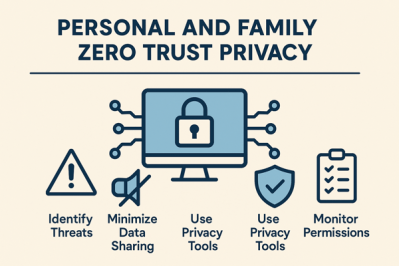
I set out to create a Zero Trust methodology for personal and family use. I have been interested in Zero Trust in information security foe years, and wondered what it might look like if I applied it to privacy on a personal level. Here is what I came up with:

PersonalZeroTrustPrivacy

Key takeaway: Secure your digital life by treating every account, device, network segment and data collection request as untrusted until proven otherwise. The roadmap below translates enterprise zero-trust ideas into a practical, repeatable program you can run at home.

1. Baseline Assessment (Week 1)

Task Why it matters How to do it
Inventory accounts, devices & data You can’t protect what you don’t know List every online account, smart-home device, computer, phone and the sensitive data each holds (e.g., health, finance, photos)12
Map trust relationships Reveals hidden attack paths Note which devices talk to one another and which accounts share log-ins or recovery e-mails34
Define risk tolerance Sets priorities Rank what would hurt most if stolen or leaked (identity, kids’ photos, medical files, etc.)5
 

2. Harden Identity & Access (Weeks 2-3)

Zero-Trust Principle Home Implementation Recommended Tools
Verify explicitly – Use a password manager to generate unique 16-character passwords – Turn on 2FA everywhere—prefer security keys for critical accounts67 1Password, Bitwarden + two FIDO2 keys
Least-privilege Share one family admin e-mail for critical services; give kids “child” or “guest” roles on devices rather than full admin rights8 Family Microsoft/Apple parental controls
Assume breach Create two recovery channels (second e-mail, phone) kept offline; store them in a fire-resistant safe6 Encrypted USB, paper copy
 

3. Secure Devices & Home Network (Weeks 3-4)

Layer Zero-Trust Control Concrete Steps
Endpoints Continuous posture checks Enable full-disk encryption, automatic patching and screen-lock timeouts on every phone, laptop and tablet56
IoT & guests Micro-segmentation Put smart-home gear on a separate SSID/VLAN; create a third “visitor” network with Internet-only access34
Router Strong identity & monitoring Change default admin password, enable WPA3, schedule automatic firmware updates and log remote-access attempts3
 

4. Protect Data Itself (Week 5)

  1. Encrypt sensitive documents locally (VeraCrypt, macOS FileVault).

  2. Use end-to-end–encrypted cloud storage (Proton Drive, Tresorit) not generic sync tools.

  3. Enable on-device backups and keep an offline copy (USB or NAS) rotated monthly16.

  4. Tokenize payment data with virtual cards and lock credit files to stop identity fraud6.

5. Data Hygiene & Minimization (Ongoing)

Habit Zero-Trust Rationale Frequency
Delete unused accounts & apps Reduce attack surface9 Quarterly
Scrub excess data (old emails, trackers, location history) Limit collateral damage if breached52 Monthly
Review social-media privacy settings Remove implicit trust in platforms9 After each major app update
Sanitize devices before resale Remove residual trust relationships When decommissioning hardware
 

6. Continuous Verification & Response (Ongoing)

  1. Automated Alerts – Turn on login-alert e-mails/SMS for major accounts and bank transactions7.

  2. Log Review Ritual – The first Sunday each month, scan password-manager breach reports, router logs and mobile “security & privacy” dashboards62.

  3. Incident Playbook – Pre-write steps for lost phone, compromised account or identity-theft notice: remote-wipe, password reset, credit freeze, police/FCC report5.

  4. Family Drills – Teach children to spot phishing, approve app permissions and ask before connecting a new device to Wi-Fi810.

7. Maturity Ladder

Level Description Typical Signals
Initial Strong passwords + MFA Few data-breach notices, but ad-tracking still visible
Advanced Network segmentation, encrypted cloud, IoT isolation No personalized ads, router logs clean
Optimal Hardware security keys, regular audits, locked credit, scripted backups Rare breach alerts, quick recovery rehearsed
 

Progress one level at a time; zero trust is a journey, not a switch.

Quick-Start 30-Day Checklist

Day Action
1-2 Complete inventory spreadsheet
3-5 Install password manager, reset top-20 account passwords
6-7 Buy two FIDO2 keys, enroll in critical accounts
8-10 Enable full-disk encryption on every device
11-15 Segment Wi-Fi (main, IoT, guest); update router firmware
16-18 Encrypt and back up sensitive documents
19-22 Delete five unused online accounts; purge old app data
23-26 Freeze credit files; set up credit alerts
27-28 Draft incident playbook; print and store offline
29-30 Family training session + schedule monthly log-review reminder
 

Why This Works

  • No implicit trust anywhere—every login, device and data request is re-authenticated or cryptographically protected34.

  • Attack surface shrinks—unique credentials, network segmentation and data minimization deny adversaries lateral movement511.

  • Rapid recovery—auditable logs, offline backups and a pre-built playbook shorten incident response time76.

Adopting these habits turns zero trust from a corporate buzzword into a sustainable family lifestyle that guards privacy, finances and peace of mind.


Support My Work

Support the creation of high-impact content and research. Sponsorship opportunities are available for specific topics, whitepapers, tools, or advisory insights. Learn more or contribute here: Buy Me A Coffee


References:

  1. https://bysafeonline.com/how-to-get-good-data-hygiene/
  2. https://github.com/Lissy93/personal-security-checklist
  3. https://www.mindpointgroup.com/blog/applying-the-principles-of-zero-trust-architecture-to-your-home-network
  4. https://www.forbes.com/sites/alexvakulov/2025/03/06/secure-your-home-network-with-zero-trust-security-best-practices/
  5. https://www.enisa.europa.eu/topics/cyber-hygiene
  6. https://guptadeepak.com/essential-security-privacy-checklist-2025-personal/
  7. https://www.fultonbank.com/Education-Center/Privacy-and-Security/Online-Privacy-Checklist
  8. https://www.reddit.com/r/privacy/comments/1jnhvmg/what_are_all_the_privacy_mustdos_that_one_should/
  9. https://privacybee.com/blog/digital-hygiene-warning-signs/
  10. https://www.infosecurityeurope.com/en-gb/blog/guides-checklists/10-everyday-practices-to-enhance-digital-security.html
  11. https://aws.amazon.com/security/zero-trust/
  12. https://www.okta.com/identity-101/zero-trust-framework-a-comprehensive-modern-security-model/
  13. https://www.reddit.com/r/PrivacyGuides/comments/1441euo/what_are_say_the_top_510_most_important/
  14. https://www.microsoft.com/en-us/security/business/zero-trust
  15. https://www.ssh.com/academy/iam/zero-trust-framework
  16. https://www.gpo.gov/docs/default-source/accessibility-privacy-coop-files/basic-privacy-101-for-public-website-04112025.pdf
  17. https://nordlayer.com/learn/zero-trust/what-is-zero-trust/
  18. https://www.priv.gc.ca/en/privacy-topics/information-and-advice-for-individuals/your-privacy-rights/02_05_d_64_tips/
  19. https://www.mindpointgroup.com/blog/securing-your-home-office-from-iot-devices-with-zta
  20. https://www.crowdstrike.com/en-us/cybersecurity-101/zero-trust-security/
  21. https://www.digitalguardian.com/blog/data-privacy-best-practices-ensure-compliance-security
  22. https://www.fortinet.com/resources/cyberglossary/how-to-implement-zero-trust
  23. https://www.cisa.gov/zero-trust-maturity-model
  24. https://www.cisco.com/site/us/en/learn/topics/networking/what-is-zero-trust-networking.html
  25. https://www.fortra.com/solutions/zero-trust
  26. https://lumenalta.com/insights/11-best-practices-for-data-privacy-and-compliance
  27. https://www.cloudflare.com/learning/security/glossary/what-is-zero-trust/
  28. https://www.fortinet.com/resources/cyberglossary/what-is-the-zero-trust-network-security-model
  29. https://www.keepersecurity.com/solutions/zero-trust-security.html
  30. https://it.cornell.edu/security-and-policy/data-hygiene-best-practices
  31. https://termly.io/resources/checklists/privacy-policy-requirements/
  32. https://www.hipaajournal.com/hipaa-compliance-checklist/
  33. https://guardiandigital.com/resources/blog/cyber-hygiene-data-protection
  34. https://dodcio.defense.gov/Portals/0/Documents/Library/ZeroTrustOverlays.pdf
  35. https://www.mightybytes.com/blog/data-privacy-checklist-free-download/
  36. https://www.reddit.com/r/AskNetsec/comments/10h1b3q/what_is_zerotrust_outside_of_the_marketing_bs/
  37. https://www.techtarget.com/searchsecurity/definition/cyber-hygiene

Why Humans Suck at Asymmetric Risk – And What We Can Do About It

Somewhere between the reptilian wiring of our brain and the ambient noise of the modern world, humans lost the plot when it comes to asymmetric risk. I see it every day—in security assessments, in boardroom decisions, even in how we cross the street. We’re hardwired to flinch at shadows and ignore the giant neon “Jackpot” signs blinking in our periphery.

Asymetry

The Flawed Lens We Call Perception

Asymmetric risk, if you’re not familiar, is the art and agony of weighing a small chance of a big win against a large chance of a small loss—or vice versa. The kind of math that makes venture capitalists grin and compliance officers lose sleep.

But here’s the kicker: we are biologically terrible at this. Our brains were optimized for sabertooth cats and tribal gossip, not venture portfolios and probabilistic threat modeling. As Kahneman and Tversky so elegantly showed, we’re much more likely to run from a $100 loss than to chase a $150 gain. That’s not risk aversion. That’s evolutionary baggage.

Biases in the Wild

Two of my favorite culprits are the availability heuristic and the affect heuristic—basically, we decide based on what we remember and how we feel. That’s fine for picking a restaurant. But for cybersecurity investments or evaluating high-impact, low-probability threats? It’s a disaster.

Anxiety, in particular, makes us avoid even minimal risks, while optimism bias has us chasing dreams on gut feeling. The result? We miss the upsides and ignore the tripwires. We undervalue data and overvalue drama.

The Real World Cost

These aren’t just academic quibbles. Misjudging asymmetric risk leads to bad policies, missed opportunities, and overblown fears. It’s the infosec team spending 90% of their time on threats that look scary on paper but never materialize—while ignoring the quiet, creeping risks with catastrophic potential.

And young people, bless their eager hearts, are caught in a bind. They have the time horizon to tolerate risk, but not the experience to see the asymmetric goldmines hiding in plain sight. Education, yes. But more importantly, exposure—to calculated risks, not just textbook theory.

Bridging the Risk Gap

So what do we do? First, we stop pretending humans are rational. We aren’t. But we can be reflective. We can build systems—risk ladders, simulations, portfolios—that force us to confront our own biases and recalibrate.

Next, we tell better stories. The framing of a risk—description versus experience—can change everything. A one-in-a-thousand chance sounds terrifying until you say “one person in a stadium full of fans.” Clarity in communication is power.

Finally, we get comfortable with discomfort. Real asymmetric opportunity often lives in ambiguity. It’s not a coin toss—it’s a spectrum. And learning to navigate that space, armed with models, heuristics, and a pinch of skepticism, is the real edge.

Wrapping Up

Asymmetric risk is both a threat and a gift. It’s the reason bad startups make billionaires and why black swan events crash markets. We can’t rewire our lizard brains, but we can out-think them.

We owe it to ourselves—and our futures—to stop sucking at asymmetric risk.

Shoutouts:

This post came from an interesting discussion with two friends: Bart and Jason. Thanks, gentlemen, for the impetus and the shared banter! 


* AI tools were used as a research assistant for this content, but human moderation and writing are also included. The included images are AI-generated.

The Mental Models of Crypto Compliance: A Hacker’s Perspective on Regulatory Risk

Let’s discuss one of the most complex and misunderstood frontiers in tech right now: cryptocurrency regulation.

This isn’t just about keeping up with new laws. It’s about building an entire mental framework to understand risk in an ecosystem that thrives on decentralization but is now colliding head-on with centralized enforcement.

Thinking

I recently gave some thought to the current state of regulation in the industry and came up with something crucial that has been missing from mainstream discourse: how we think about compliance in crypto matters just as much as what we do about it.

Data Layers and the Devil in the Details

Here’s the first truth bomb: not all on-chain data is equal.

You’ve got raw data — think: transaction hashes, sender/receiver addresses, gas fees. Then there’s abstracted data — the kind analysts love, like market cap and trading volume.

Regulators treat these differently, and so should we. If you’re building tools or making investment decisions without distinguishing between raw and abstracted data, you’re flying blind.

What struck me was how clearly this breakdown mirrors infosec risk models. Think of raw data like packet captures. Useful, granular, noisy. Abstracted data is your dashboard — interpretive and prone to bias. You need both to build situational awareness, but you’d better know which is which.

Keep It Simple (But Not Simplistic)

In cybersecurity, we talk a lot about Occam’s Razor. The simplest explanation isn’t always right, but the most efficient solution that meets the requirements usually is.

Crypto compliance right now? It’s bloated. Teams are building Byzantine workflows with multiple overlapping audits, clunky spreadsheets, and policy documents that look like the tax code.

The smarter play is automation. Real-time compliance tooling. Alerting systems that spot anomalies before regulators do. Because let’s be honest — the cost of “too late” in crypto is often existential.

Reverse Engineering Risk: The Inversion Model

Here’s a mental model that should be part of every crypto project’s DNA: Inversion.

Instead of asking “What does good compliance look like?”, start with: “How do we fail?”

Legal penalties. Reputation hits. Token delistings. Work backward from these outcomes and you’ll find the root causes: weak KYC, vague policies, and unauditable code. This is classic hacker thinking — start from the failure state and reverse engineer defenses.

It’s not about paranoia. It’s about resilience.

Structured Due Diligence > FOMO

The paper references EY’s six-pillar framework for token risk analysis — technical, legal, cybersecurity, financial, governance, and reputational. That’s a solid model.

But the key insight is this: frameworks turn chaos into clarity.

It reminds me of the early days of PCI-DSS. Everyone hated it, but the structured checklist forced companies to at least look under the hood. In crypto, where hype still trumps hard questions, a due diligence framework is your best defense against FOMO-driven disaster.

Global Regulation: Same Storm, Different Boats

With MiCA rolling out in the EU and the US swinging between enforcement and innovation depending on who’s in office, we’re entering a phase of compliance relativity.

You can’t memorize the rules. They’ll change next quarter. What you can do is build adaptable frameworks that let you assess risk regardless of the jurisdiction.

That means dedicated compliance committees. Cross-functional teams. Automated KYC that actually works. And most importantly: ongoing, not one-time, risk assessment.

Final Thoughts: The Future Belongs to Systems Thinkers

Crypto isn’t the Wild West anymore. It’s more like the early days of the Internet — still full of potential, still fragile, and now squarely in regulators’ crosshairs.

The organizations that survive won’t be the ones with the flashiest NFTs or the most Discord hype. They’ll be the ones who take compliance seriously — not as a bureaucratic burden, but as a strategic advantage.

Mental models like inversion, Occam’s Razor, and structured due diligence aren’t just academic. They’re how we turn regulatory chaos into operational clarity.

And if you’re still thinking of compliance as a checklist, rather than a mindset?

You’re already behind…


* AI tools were used as a research assistant for this content, but human moderation and writing are also included. The included images are AI-generated.
Market Intelligence for the Rest of Us: Building a $2K AI for Startup Signals

It’s a story we hear far too often in tech circles: powerful tools locked behind enterprise price tags. If you’re a solo founder, indie investor, or the kind of person who builds MVPs from a kitchen table, the idea of paying $2,000 a month for market intelligence software sounds like a punchline — not a product. But the tide is shifting. Edge AI is putting institutional-grade analytics within reach of anyone with a soldering iron and some Python chops.

Pi400WithAI

Edge AI: A Quiet Revolution

There’s a fascinating convergence happening right now: the Raspberry Pi 400, an all-in-one keyboard-computer for under $100, is powerful enough to run quantized language models like TinyLLaMA. These aren’t toys. They’re functional tools that can parse financial filings, assess sentiment, and deliver real-time insights from structured and unstructured data.

The performance isn’t mythical either. When you quantize a lightweight LLM to 4-bit precision, you retain 95% of the accuracy while dropping memory usage by up to 70%. That’s a trade-off worth celebrating, especially when you’re paying 5–15 watts to keep the whole thing running. No cloud fees. No vendor lock-in. Just raw, local computation.

The Indie Investor’s Dream Stack

The stack described in this setup is tight, scrappy, and surprisingly effective:

  • Raspberry Pi 400: Your edge AI hardware base.

  • TinyLLaMA: A lean, mean 1.1B-parameter model ready for signal extraction.

  • VADER: Old faithful for quick sentiment reads.

  • SEC API + Web Scraping: Data collection that doesn’t rely on SaaS vendors.

  • SQLite or CSV: Because sometimes, the simplest storage works best.

If you’ve ever built anything in a bootstrapped environment, this architecture feels like home. Minimal dependencies. Transparent workflows. And full control of your data.

Real-World Application, Real-Time Signals

From scraping startup news headlines to parsing 10-Ks and 8-Ks from EDGAR, the system functions as a low-latency, always-on market radar. You’re not waiting for quarterly analyst reports or delayed press releases. You’re reading between the lines in real time.

Sentiment scores get calculated. Signals get aggregated. If the filings suggest a risk event while the news sentiment dips negative? You get a notification. Email, Telegram bot, whatever suits your alert style.

The dashboard component rounds it out — historical trends, portfolio-specific signals, and current market sentiment all wrapped in a local web UI. And yes, it works offline too. That’s the beauty of edge.

Why This Matters

It’s not just about saving money — though saving over $46,000 across three years compared to traditional tools is no small feat. It’s about reclaiming autonomy in an industry that’s increasingly centralized and opaque.

The truth is, indie analysts and small investment shops bring valuable diversity to capital markets. They see signals the big firms overlook. But they’ve lacked the tooling. This shifts that balance.

Best Practices From the Trenches

The research set outlines some key lessons worth reiterating:

  • Quantization is your friend: 4-bit LLMs are the sweet spot.

  • Redundancy matters: Pull from multiple sources to validate signals.

  • Modular design scales: You may start with one Pi, but load balancing across a cluster is just a YAML file away.

  • Encrypt and secure: Edge doesn’t mean exempt from risk. Secure your API keys and harden your stack.

What Comes Next

There’s a roadmap here that could rival a mid-tier SaaS platform. Social media integration. Patent data. Even mobile dashboards. But the most compelling idea is community. Open-source signal strategies. GitHub repos. Tutorials. That’s the long game.

If we can democratize access to investment intelligence, we shift who gets to play — and who gets to win.


Final Thoughts

I love this project not just for the clever engineering, but for the philosophy behind it. We’ve spent decades building complex, expensive systems that exclude the very people who might use them in the most novel ways. This flips the script.

If you’re a founder watching the winds shift, or an indie VC tired of playing catch-up, this is your chance. Build the tools. Decode the signals. And most importantly, keep your stack weird.

How To:


Build Instructions: DIY Market Intelligence

This system runs best when you treat it like a home lab experiment with a financial twist. Here’s how to get it up and running.

🧰 Hardware Requirements

  • Raspberry Pi 400 ($90)

  • 128GB MicroSD card ($25)

  • Heatsink/fan combo (optional, $10)

  • Reliable internet connection

🔧 Phase 1: System Setup

  1. Install Raspberry Pi OS Desktop

  2. Update and install dependencies

    sudo apt update -y && sudo apt upgrade -y
    sudo apt install python3-pip -y
    pip3 install pandas nltk transformers torch
    python3 -c "import nltk; nltk.download('all')"
    

🌐 Phase 2: Data Collection

  1. News Scraping

    • Use requests + BeautifulSoup to parse RSS feeds from financial news outlets.

    • Filter by keywords, deduplicate articles, and store structured summaries in SQLite.

  2. SEC Filings

    • Install sec-api:

      pip3 install sec-api
      
    • Query recent 10-K/8-Ks and store the content locally.

    • Extract XBRL data using Python’s lxml or bs4.


🧠 Phase 3: Sentiment and Signal Detection

  1. Basic Sentiment: VADER

    from nltk.sentiment.vader import SentimentIntensityAnalyzer
    analyzer = SentimentIntensityAnalyzer()
    scores = analyzer.polarity_scores(text)
    
  2. Advanced LLMs: TinyLLaMA via Ollama

    • Install Ollama: ollama.com

    • Pull and run TinyLLaMA locally:

      ollama pull tinyllama
      ollama run tinyllama
      
    • Feed parsed content and use the model for classification, signal extraction, and trend detection.


📊 Phase 4: Output & Monitoring

  1. Dashboard

    • Use Flask or Streamlit for a lightweight local dashboard.

    • Show:

      • Company-specific alerts

      • Aggregate sentiment trends

      • Regulatory risk events

  2. Alerts

    • Integrate with Telegram or email using standard Python libraries (smtplibpython-telegram-bot).

    • Send alerts when sentiment dips sharply or key filings appear.


Use Cases That Matter

🕵️ Indie VC Deal Sourcing

  • Monitor startup mentions in niche publications.

  • Score sentiment around funding announcements.

  • Identify unusual filing patterns ahead of new rounds.

🚀 Bootstrapped Startup Intelligence

  • Track competitors’ regulatory filings.

  • Stay ahead of shifting sentiment in your vertical.

  • React faster to macroeconomic events impacting your market.

⚖️ Risk Management

  • Flag negative filing language or missing disclosures.

  • Detect regulatory compliance risks.

  • Get early warning on industry disruptions.


Lessons From the Edge

If you’re already spending $20/month on ChatGPT and juggling half a dozen spreadsheets, consider this your signal. For under $2K over three years, you can build a tool that not only pays for itself, but puts you on competitive footing with firms burning $50K on dashboards and dashboards about dashboards.

There’s poetry in this setup: lean, fast, and local. Like the best tools, it’s not just about what it does — it’s about what it enables. Autonomy. Agility. Insight.

And perhaps most importantly, it’s yours.


Support My Work and Content Like This

Support the creation of high-impact content and research. Sponsorship opportunities are available for specific topics, whitepapers, tools, or advisory insights. Learn more or contribute here: Buy Me A Coffee


* AI tools were used as a research assistant for this content, but human moderation and writing are also included. The included images are AI-generated.


Tool Deep Dive: Mental Models Tracker + AI Insights

The productivity and rational-thinking crowd has long loved mental models. We memorize them. We quote them. We sprinkle them into conversations like intellectual seasoning. But here’s the inconvenient truth: very few of us actually track how we use them. Even fewer build systems to reinforce their practical application in daily life. That gap is where this tool deep dive lands.

MentalModels

The Problem: Theory Without a Feedback Loop

You know First Principles Thinking, Inversion, Opportunity Cost, Hanlon’s Razor, the 80/20 Rule, and the rest. But do you know if you’re actually applying them consistently? Or are they just bouncing around in your head, waiting to be summoned by a Twitter thread?

In an increasingly AI-enabled work landscape, knowing mental models isn’t enough. Systems thinking alone won’t save you. Implementation will.

Why Now: The Implementation Era

AI isn’t just a new toolset. It’s a context shifter. We’re all being asked to think faster, act more strategically, and manage complexity in real-time. It’s not just about understanding systems, but executing decisions with clarity and intention. That means our cognitive infrastructure needs reinforcing.

The Tracker: One Week to Conscious Application

I ran a simple demo: one week, one daily journal template, tracking how mental models showed up (or could have) in real-world decisions.

  • A decision or scenario I encountered
  • Which models I applied (or neglected)
  • The outcome (or projected cost of neglect)
  • Reflections on integration with MATTO

You can download the journal template here.

AI Prompt: Your On-Demand Decision Partner

Here’s the ChatGPT prompt I used daily:

“I’m going to describe a situation I encountered today. I want you to help me analyze it using the following mental models: First Principles, Inversion, Opportunity Cost, Diminishing Returns, Hanlon’s Razor, Parkinson’s Law, Loss Aversion, Switching Costs, Circle of Competence, Regret Minimization, Pareto Principle, and Game Theory. First, tell me which models are most relevant. Then, walk me through how to apply them. Then, ask me reflective questions for journaling.”

Integration with MATTO: Tracking the True Cost

In my journaling system, I use MATTO (Money, Attention, Time, Trust, Opportunity) to score decisions. After a model analysis, I tag entries with their relevant MATTO implications:

  • Did I spend unnecessary attention by failing to invert?
  • Did loss aversion skew my sense of opportunity?
  • Was trust eroded due to ignoring second-order consequences?

Final Thought: Self-Awareness at Scale

We don’t need more models. We need mechanisms.

This is a small experiment in building them. Give it a week. Let your decisions become a training dataset. The clarity you’ll gain might just be the edge you’re looking for.

Support My Work

Support the creation of high-impact content and research. Sponsorship opportunities are available for specific topics, whitepapers, tools, or advisory insights. Learn more or contribute here: Buy Me A Coffee


* AI tools were used as a research assistant for this content, but human moderation and writing are also included. The included images are AI-generated.

🧭 Beyond Crystal Balls: Making Better Financial Bets with Bayesian Brains


If you’ve ever wondered whether your financial model might be more fiction than forecast, you’re not alone. 🌀 We’ve all built (or trusted) a model that felt solid—until the market laughed in its face. Turns out, model uncertainty is one of the biggest blind spots in finance.

Luckily, Bayesian methods don’t just shine a flashlight into the dark—they help map the cave while you’re in it. Let’s talk about why that matters.

Infograph060925 2

🎲 What Is Model Uncertainty, Really?

Imagine you’re planning a road trip, but you’re not sure if your GPS is even set to the right state. That’s model uncertainty. It’s not just about the data, it’s about whether the entire framework you’re using is the right one.

In finance, this shows up when:

* Your model assumes a normal distribution, but reality goes fat-tailed 📉
*You pick the “wrong” factors in your investment model
*Policy or market dynamics shift so fast your model gets stale
Bayesian approaches handle this by saying: “Why pick one model when you can blend several?” Using Bayesian model averaging, you don’t bet on a single winner—you weigh your bets across multiple contenders, each with their own probability.

🧠 Beating Bias: Bayesian Learning to the Rescue

One of the sneaky traps investors fall into is recency bias—the tendency to overweigh recent events. (Just ask anyone who panic-sold at the wrong time. 🙋‍♂️)

Bayesian learning gently reins that in. It updates your beliefs steadily, incorporating new data without tossing out everything that came before.

It’s like the opposite of headline-chasing—it’s strategy based on the full picture.

🚫 Don’t Let Confidence Become a Trap

Bayesian models also help us avoid a dangerous pitfall: false confidence. Just because a model spits out precise numbers doesn’t mean those numbers are right. Rigid models often fail to account for rare events or black swans.

Bayesian thinking bakes uncertainty right into the math. Instead of saying, “X will happen,” it says, “Here’s the range of what might happen, and how likely each scenario is.” That humility makes for much smarter risk management.

The Takeaway

Bayesian tools aren’t magic. They won’t hand you a crystal ball or guarantee 20% returns. But they will help you:

🔄 Stay adaptive
📊 Balance competing risks
🧩 Account for what you don’t know
⚖️ Make better decisions over time

In a world where models can deceive and data changes daily, Bayesian thinking is less about finding the perfect answer—and more about asking the right questions.

Stay curious. Question your tools. And never stop updating your beliefs.


Support the creation of high-impact content and research. Sponsorship opportunities are available for specific topics, whitepapers, tools, or advisory insights. Learn more or contribute here: Buy Me A Coffee

* AI tools were used as a research assistant for this content, but human moderation and writing are also included. The included images are AI-generated.

🔍 Taming the Chaos: Bayesian Methods in Real-World Market Mayhem

Let’s face it: markets can be absolute chaos. One day, crypto is mooning 🚀. The next? Your portfolio looks like it fell down an elevator shaft. Whether it’s tech stocks, foreign currencies, or those mysterious private equity plays—uncertainty is the name of the game.

So how do we make sense of the madness? That’s where Bayesian methods shine. Let’s explore how this approach handles messy, real-world investment scenarios in ways that feel more like strategy and less like guesswork.

Infograph060925 1

📉 Tech Stocks: The Volatility Playground

Tech stocks are the drama queens of the financial world—flashy, emotional, and occasionally brilliant. Predicting their behavior is like trying to forecast what your cat will do next. (Spoiler: chaos. 🐱)

With Bayesian methods, we don’t just cross our fingers and hope. We take what we know (past earnings, macroeconomic data, investor sentiment), and update that with each quarterly report, policy shift, or product launch.

Think of it like a smart thermostat—always learning, adjusting, and optimizing based on the latest readings.

🪙 Cryptocurrency: Where Rules Go to Die

If tech stocks are drama queens, crypto is the rebellious teenager who ignores curfews and reinvents money while doing it. 📉📈📉📈

Bayesian techniques help us build probabilistic models that can adapt to the wild swings. Instead of betting everything on one model (like “Bitcoin always rebounds”), we average across several plausible views—some bullish, some bearish—based on real-time data.

It’s like having a squad of advisors whispering in your ear instead of just the loudest one at the table.

💱 Foreign Currency: Subtle But Deadly

Foreign currency markets don’t always get the headlines, but wow—can they sneak up on you. From trade wars to interest rate moves, they’re constantly shifting. And if you’re holding investments abroad? You’re automatically playing in this game.

Here, Bayesian methods work wonders by adjusting for spillovers—like how a U.S. Fed move might impact the Euro or Aussie dollar. Bayesian models can detect these effects and shift forecasts accordingly.

They’re like sensitive seismographs for financial tremors you didn’t even know were coming.

🧠 Decision-Making, Upgraded

Traditional models often get stuck in their assumptions—like an old GPS insisting you drive through a lake. Bayesian models say, “Whoa, new data just came in—let’s re-route.”

They help us:

Stay flexible in fast-changing conditions
Avoid overreacting to noise
Balance competing risks intelligently

And yeah, they take a little effort to understand. But trust me—once you see the results, it’s hard to go back.

Next up: In our final post of this series, we’ll dig into how Bayesian methods help tackle one of the biggest hidden risks in finance—model uncertainty. It’s like questioning whether your map is even the right one.

Until then—keep learning, stay skeptical, and treat your beliefs like software: always in beta. 🧠💻


* AI tools were used as a research assistant for this content, but human moderation and writing are also included. The included images are AI-generated.

🧠 Betting on Beliefs: Why Bayesian Thinking Belongs in Your Investment Toolbox

If you’ve ever made an investment decision that felt like a coin toss, welcome to the club. 📉📈 Uncertainty is baked into finance, no matter how many spreadsheets or models we throw at it. But here’s the good news: there’s a smarter way to deal with this unpredictability. It’s called Bayesian thinking—and it’s kind of like upgrading your brain with a statistics-powered GPS for navigating risky terrain.

ThinkingNotes

Let’s unpack this, not as a PhD thesis, but like we’re two old friends talking about the markets over coffee (and maybe some bourbon 🍸 if it’s been that kind of quarter).

What’s Bayesian Thinking Anyway?

Named after Thomas Bayes—a statistician and theologian with a knack for probability—Bayesian thinking is all about updating your beliefs as new data comes in. Imagine you’re sailing a boat in foggy weather. You can’t see much, but every ping from your radar helps you refine your course. That’s Bayesian logic at work: start with a guess (your prior), then update that guess as more info rolls in (your posterior).

In the world of investing, this isn’t just helpful—it’s survival gear.

Why This Matters More Than Ever

Markets today feel like riding a rollercoaster with no seatbelt. From crypto crashes to interest rate whiplash, traditional models often fail to keep up. Bayesian methods thrive in these situations because they:

Incorporate uncertainty (instead of pretending it’s not there)
Constantly learn and adapt as conditions change
Handle model errors and parameter guesswork with more nuance than rigid formulas

In other words, Bayesian tools are like having a financial weatherman who admits they don’t know everything—but gets more accurate every time it rains.

Real Talk: Why I Use This Stuff

Here’s a dirty little secret: no model gets it right all the time. But Bayesian approaches admit that up front. They say, “Hey, let’s not commit to one truth. Let’s explore a bunch of possibilities and adjust as we go.” That humility is powerful. Especially in markets where the only constant is change.

Plus, it fits with how humans actually think. We revise our opinions as we learn—why shouldn’t our investment models do the same?

Final Thought: Don’t Be a Dinosaur 🦕 in a Digital Jungle

If you’re still using old-school statistical tools that ignore uncertainty or can’t adapt on the fly, you’re setting yourself up to get blindsided. Bayesian methods aren’t just for math geeks—they’re for anyone serious about managing risk in the real world.

So next time you’re staring at your portfolio, wondering what the heck just happened, ask yourself this: “What do I believe now, and how should I change my mind based on what I just learned?”

That’s the Bayesian mindset.

Stay adaptive. Stay curious. Stay a little skeptical. And as always—question everything.

Coming up next: we’ll dive into how this plays out with real market chaos—from crypto crashes to the currency jungle. 🪙💱📊


* AI tools were used as a research assistant for this content, but human moderation and writing are also included. The included images are AI-generated.


New Whitepaper: Deeper Dive on Digital Asset Investing

Several folks have asked me to dive deeper into the digital asset investing post and discuss my thoughts on holding digital assets. 

DigitalAssets

That said, I spent some time working with my AI tools and researching deeper into the thoughts I shared earlier. 

The outcome is a much longer whitepaper, which you can download here if you are interested.

If you enjoy it, or want to discuss, please feel free to email me and let me know your thoughts (bhuston@microsolved.com). 

You can download the whitepaper here: https://www.dropbox.com/scl/fi/hkzywtukx2buhb05b92v4/Navigating-the-Digital-Asset-Investment-Landscape_.pdf?rlkey=5z0pag4hr4e3sk0ohck6j0yn0&dl=0


Disclaimer:
This content is provided for informational and research purposes only. It does not constitute financial, investment, legal, or tax advice. I am not a licensed financial advisor, and nothing in this document should be interpreted as a recommendation to buy, sell, or hold any financial instrument or pursue any specific strategy. Always consult a qualified financial professional before making any financial decisions.

The Blended Workforce: Integrating AI Co-Workers into Human Teams

The workplace is evolving. Artificial Intelligence (AI) is no longer a distant concept; it’s now a tangible part of our daily operations. From drafting emails to analyzing complex data sets, AI is becoming an integral member of our teams. This shift towards a “blended workforce”—where humans and AI collaborate—requires us to rethink our roles, responsibilities, and the very fabric of our work culture.

AITeamMember

Redefining Roles in the Age of AI

In this new paradigm, AI isn’t just a tool; it’s a collaborator. It handles repetitive tasks, processes vast amounts of data, and even offers insights that can influence decision-making. However, the human touch remains irreplaceable. Creativity, empathy, and ethical judgment are domains where humans excel and AI still lags. The challenge lies in harmonizing these strengths to create a cohesive team.

Organizations like Duolingo and Shopify are pioneering this integration. They’ve adopted AI-first strategies, emphasizing the augmentation of human capabilities rather than replacement. Employees are encouraged to develop AI proficiency, ensuring they can work alongside these digital counterparts effectively.

Navigating Ethical Waters

With great power comes great responsibility. The integration of AI into the workforce brings forth ethical considerations that cannot be ignored. Transparency is paramount. Employees should be aware when they’re interacting with AI and understand how decisions are made. This clarity builds trust and ensures accountability.

Moreover, biases embedded in AI algorithms can perpetuate discrimination if not addressed. Regular audits and diverse data sets are essential to mitigate these risks. Ethical AI implementation isn’t just about compliance; it’s about fostering an inclusive and fair workplace.

Upskilling for the Future

As AI takes on more tasks, the skill sets required for human employees are shifting. Adaptability, critical thinking, and emotional intelligence are becoming increasingly valuable. Training programs must evolve to equip employees with these skills, ensuring they remain relevant and effective in a blended workforce.

Companies are investing in personalized learning paths, leveraging AI to identify skill gaps and tailor training accordingly. This approach not only enhances individual growth but also strengthens the organization’s overall adaptability.

Measuring Success in a Blended Environment

Integrating AI into teams isn’t just about efficiency; it’s about enhancing overall productivity and employee satisfaction. Regular feedback loops, transparent communication, and clear delineation of roles are vital. By continuously assessing the impact of AI on team dynamics, organizations can make informed adjustments, ensuring both human and AI members contribute optimally.

Embracing the Hybrid Future

The blended workforce is not a fleeting trend; it’s the future of work. By thoughtfully integrating AI into our teams, addressing ethical considerations, and investing in continuous learning, we can create a harmonious environment where both humans and AI thrive. It’s not about choosing between man or machine; it’s about leveraging the strengths of both to achieve greater heights.


Support the creation of high-impact content and research. Sponsorship opportunities are available for specific topics, whitepapers, tools, or advisory insights. Learn more or contribute here: Buy Me A Coffee


* AI tools were used as a research assistant for this content, but human moderation and writing are also included. The included images are AI-generated.