Every day, we hear about the massive energy demands of AI models: towering racks of accelerators, huge data‑centres sweltering under cooling systems, and power bills climbing as the compute hunger grows. What if the next frontier for AI infrastructure wasn’t on Earth at all, but in space? That’s the provocative vision behind Project Suncatcher, a new research initiative announced by Google to explore a space‑based, solar‑powered AI infrastructure using satellite constellations.
What is Project Suncatcher?
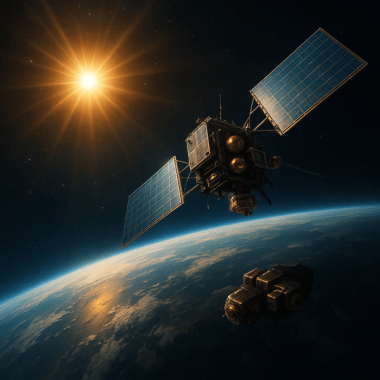
In a nutshell: Google’s researchers have proposed a system in which instead of sprawling Earth‑based data centres, AI compute is shifted to a network (constellation) of satellites in low Earth orbit (LEO), powered by sunlight, linked via optical (laser) inter‑satellite communications, and designed for the compute‑intensive workloads of modern machine‑learning.
- The orbit: A dawn–dusk sun‑synchronous LEO to maintain continuous sunlight exposure.
- Solar productivity: Up to 8x more effective than Earth-based panels due to absence of atmosphere and constant sunlight.
- Compute units: Specialized hardware like Google’s TPUs, tested for space conditions and radiation.
- Inter-satellite links: Optical links at tens of terabits per second, operating over short distances in tight orbital clusters.
- Prototyping: First satellite tests planned for 2027 in collaboration with Planet.
Why is Google Doing This?
1. Power & Cooling Bottlenecks
Terrestrial data centres are increasingly constrained by power, cooling, and environmental impact. Space offers an abundant solar supply and reduces many of these bottlenecks.
2. Efficiency Advantage
Solar panels in orbit are drastically more efficient, yielding higher power per square meter than ground systems.
3. Strategic Bet
This is a moonshot—an early move in what could become a key infrastructure play if space-based compute proves viable.
4. Economic Viability
Launch costs dropping to $200/kg to LEO would make orbital AI compute cost-competitive with Earth-based data centres on a power basis.
Major Technical & Operational Challenges
- Formation flying & optical links: High-precision orbital positioning and reliable laser communications are technically complex.
- Radiation tolerance: Space radiation threatens hardware longevity; early tests show promise but long-term viability is uncertain.
- Thermal management: Heat dissipation without convection is a core engineering challenge.
- Ground links & latency: High-bandwidth optical Earth links are essential but still developing.
- Debris & regulatory risks: Space congestion and environmental impact from satellites remain hot-button issues.
- Economic timing: Launch cost reductions are necessary to reach competitive viability.
Implications & Why It Matters
- Shifts in compute geography: Expands infrastructure beyond Earth, introducing new attack and failure surfaces.
- Cybersecurity challenges: Optical link interception, satellite jamming, and AI misuse must be considered.
- Environmental tradeoffs: Reduces land and power use on Earth but may increase orbital debris and launch emissions.
- Access disparity: Could create gaps between those who control orbital compute and those who don’t.
- AI model architecture: Suggests future models may rely on hybrid Earth-space compute paradigms.
My Reflections
I’ve followed large-scale compute for years, and the idea of AI infrastructure in orbit feels like sci-fi—but is inching toward reality. Google’s candid technical paper acknowledges hurdles, but finds no physics-based showstoppers. Key takeaway? As AI pushes physical boundaries, security and architecture need to scale beyond the stratosphere.
Conclusion
Project Suncatcher hints at a future where data centres orbit Earth, soaking up sunlight, and coordinating massive ML workloads across space. The prototype is still years off, but the signal is clear: the age of terrestrial-only infrastructure is ending. We must begin securing and architecting for a space-based AI future now—before the satellites go live.
What to Watch
- Google’s 2027 prototype satellite launch
- Performance of space-grade optical interconnects
- Launch cost trends (< $200/kg)
- Regulatory and environmental responses
- Moves by competitors like SpaceX, NVIDIA, or governments
References
- https://blog.google/technology/research/google-project-suncatcher/
- https://research.google/blog/exploring-a-space-based-scalable-ai-infrastructure-system-design/
- https://services.google.com/fh/files/misc/suncatcher_paper.pdf
- https://9to5google.com/2025/11/04/google-project-suncatcher/
- https://tomshardware.com/tech-industry/artificial-intelligence/google-exploring-putting-ai-data-centers-in-space-project-suncatcher
- https://www.theguardian.com/technology/2025/nov/04/google-plans-to-put-datacentres-in-space-to-meet-demand-for-ai
 Not Quite Random