If you’ve ever wondered whether your financial model might be more fiction than forecast, you’re not alone. 🌀 We’ve all built (or trusted) a model that felt solid—until the market laughed in its face. Turns out, model uncertainty is one of the biggest blind spots in finance.
Luckily, Bayesian methods don’t just shine a flashlight into the dark—they help map the cave while you’re in it. Let’s talk about why that matters.
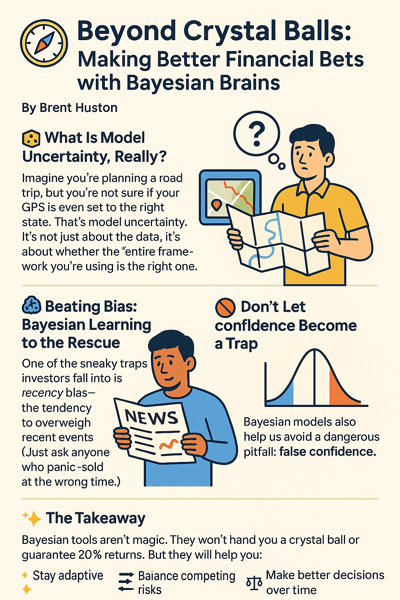
What Is Model Uncertainty, Really?
In finance, this shows up when:
Beating Bias: Bayesian Learning to the Rescue
One of the sneaky traps investors fall into is recency bias—the tendency to overweigh recent events. (Just ask anyone who panic-sold at the wrong time. 🙋♂️)
Bayesian learning gently reins that in. It updates your beliefs steadily, incorporating new data without tossing out everything that came before.
Don’t Let Confidence Become a Trap
Bayesian models also help us avoid a dangerous pitfall: false confidence. Just because a model spits out precise numbers doesn’t mean those numbers are right. Rigid models often fail to account for rare events or black swans.
Bayesian thinking bakes uncertainty right into the math. Instead of saying, “X will happen,” it says, “Here’s the range of what might happen, and how likely each scenario is.” That humility makes for much smarter risk management.
The Takeaway
Bayesian tools aren’t magic. They won’t hand you a crystal ball or guarantee 20% returns. But they will help you:
In a world where models can deceive and data changes daily, Bayesian thinking is less about finding the perfect answer—and more about asking the right questions.
Support the creation of high-impact content and research. Sponsorship opportunities are available for specific topics, whitepapers, tools, or advisory insights. Learn more or contribute here: Buy Me A Coffee
* AI tools were used as a research assistant for this content, but human moderation and writing are also included. The included images are AI-generated.
 Not Quite Random